Our Services
Bone Grafting: Rebuilding the Foundation for Implants
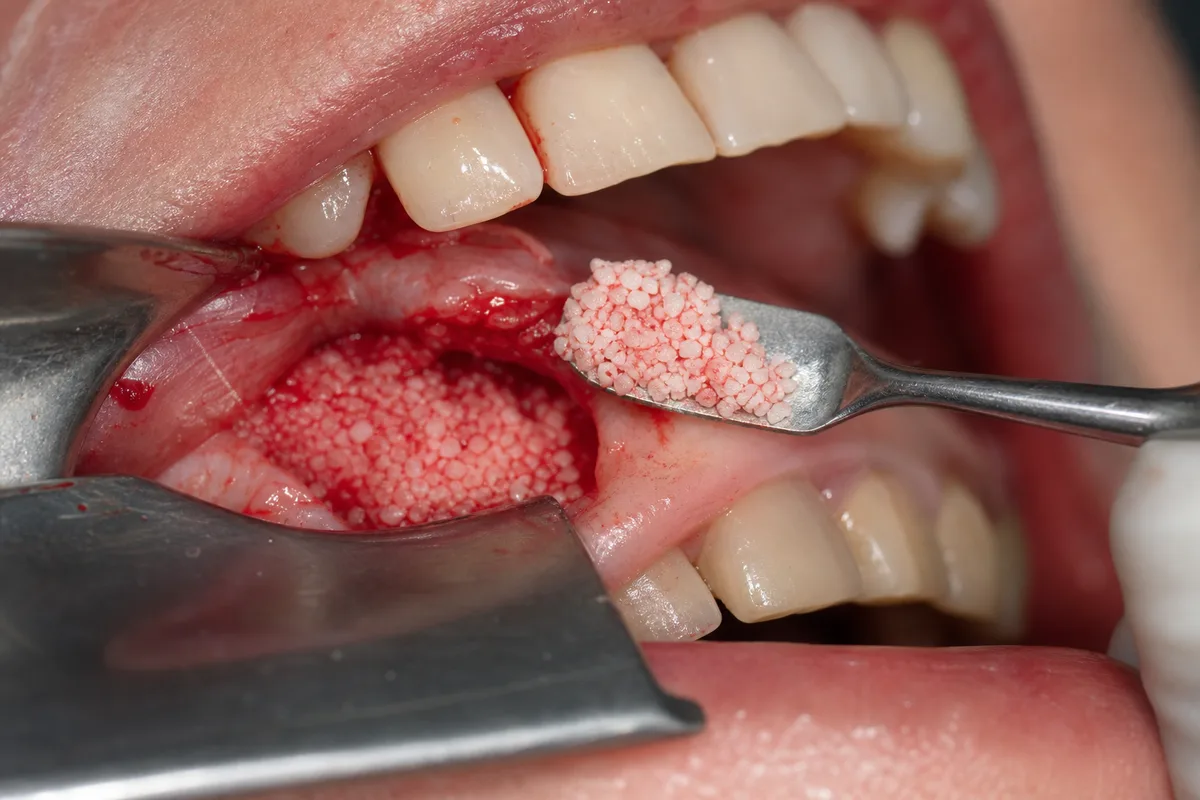
Bone grafting in dentistry is the process of adding material to the jaw to rebuild volume that has been lost, most often so that a dental implant can be placed where there is currently not enough bone to hold one.
It sounds more dramatic than it usually is. The majority of dental grafts are small, done under local anesthetic in under an hour, and heal uneventfully.
Why bone disappears
The bone that surrounds a tooth root exists because of the tooth. It is maintained by the forces transmitted through the periodontal ligament during chewing. Remove the tooth and that stimulus stops.
Resorption begins immediately and is fastest in the first six months, with studies typically showing substantial loss of ridge width and a smaller loss of height within the first year. It continues slowly thereafter, which is why a tooth lost in a person's thirties leaves a very different ridge by their fifties.
Periodontal disease destroys bone directly through inflammation, often leaving a deficient site even before the tooth is removed. Long-term denture wear accelerates ridge loss through pressure, infection and trauma cause localized defects, and in the upper back jaw the sinus cavity tends to expand downward into the space left by missing molars.
The main procedures
Socket preservation is the most common and the most valuable. Graft material is placed into the socket immediately after an extraction and covered with a membrane. It does not prevent all resorption but it preserves substantially more ridge volume than leaving the socket empty, and it frequently means no further grafting is needed later. If you are having a tooth removed and might want an implant one day, this is the conversation to have before the extraction, not after.
Ridge augmentation rebuilds a ridge that has already collapsed, adding width, height or both, often with a membrane and sometimes with a titanium mesh or a block graft to maintain the shape during healing.
A sinus lift addresses the upper back jaw, where the floor of the maxillary sinus often sits too low for an implant. The sinus membrane is gently elevated and graft material placed beneath it. A lateral approach is used when a substantial gain is needed; a less invasive crestal approach through the implant site itself works when only a few millimeters are required.
Guided bone regeneration is the general term for using a barrier membrane to keep faster-growing soft tissue out of a defect so that slower-growing bone can fill it.
What the graft material is
Autograft, your own bone harvested from elsewhere in the jaw, is the biological gold standard because it contains living cells and growth factors. It requires a second surgical site, which is its main drawback.
Allograft is processed human donor bone from a tissue bank. It is thoroughly sterilized and screened, has a long safety record, and is the most commonly used material in dental grafting. Xenograft, usually processed bovine bone, provides an excellent scaffold and resorbs very slowly, which helps maintain volume over time. Alloplast is fully synthetic, typically a calcium phosphate ceramic.
None of these becomes your bone directly. They act as a scaffold that your own bone grows into and gradually replaces or incorporates, a process called osteoconduction. Some materials also stimulate bone formation. Growth factor preparations and platelet concentrates derived from your own blood are sometimes added to accelerate healing.
The procedure and healing
Most dental grafts are done under local anesthetic, with sedation available. The site is accessed, cleaned of any infected or granulation tissue, the graft is placed, a membrane positioned, and the gum closed with sutures.
Expect swelling peaking around day two or three, mild to moderate discomfort managed with over-the-counter medication for most cases, and instructions that matter more than usual: do not disturb the site, avoid rinsing forcefully for the first day, no smoking, no straws, soft diet, and sleep with your head slightly elevated. After a sinus lift, also avoid blowing your nose forcefully and sneeze with your mouth open for two weeks.
Healing to the point where an implant can be placed takes roughly four to nine months depending on the size and type of graft, with socket preservation at the shorter end and large ridge augmentations or lateral sinus lifts at the longer end. Sometimes an implant is placed at the same time as a smaller graft.
Success and what affects it
Dental bone grafting is highly predictable, with success commonly reported above ninety percent for routine cases. The most frequent complication is early exposure of the membrane through the gum, which can usually be managed but may reduce the amount of bone gained.
Smoking is the strongest modifiable risk factor and substantially increases failure. Uncontrolled diabetes, certain bone medications, previous radiation to the jaws, and untreated gum disease all matter. Following the post-operative instructions genuinely affects the outcome here more than in most dental procedures.
The alternative to grafting is usually a different restoration: a bridge, a partial denture, or in some cases shorter or narrower implants or implants placed at angles to use available bone. Those are legitimate options worth discussing. If you have been told you do not have enough bone for an implant, call Cedar Creek Dentistry in Portland and let us look at what is actually there.
Questions about your own care? The team at The Best Dentist In Portland, Oregon is happy to help — call us at (503) 646-1811.
This article is for general information only and is not medical advice.