Our Services
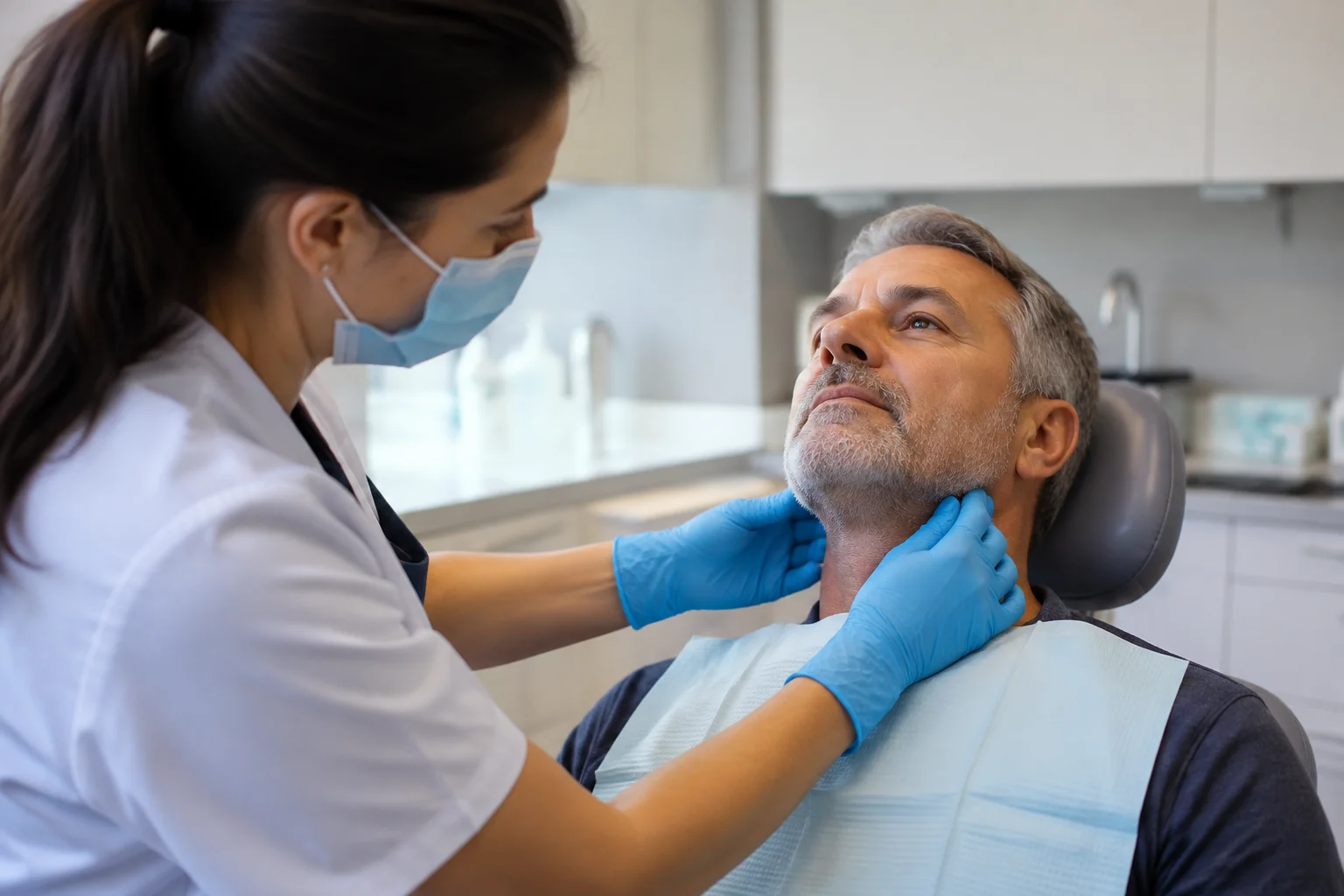
Oral Cancer Screening: A Two-Minute Check That Matters
Oral and oropharyngeal cancers are diagnosed in tens of thousands of people in the United States each year, and the five-year survival rate has remained stubbornly around sixty-five percent for decades. That figure is not because the disease is untreatable. It is because most cases are found late.
Found early, while still localized, survival rates are considerably better. The screening that makes that difference takes about two minutes and is part of a routine dental examination.
What the screening involves
It is a systematic visual and tactile examination. We look at the lips, the inside of the cheeks, the gums, the roof and floor of the mouth, the tonsillar area and the back of the throat, and the tongue, including lifting it and examining the underside and the lateral borders, which is where a large share of oral cancers actually arise and where you would never look yourself.
We palpate the floor of the mouth and the tissues of the neck and under the jaw, checking for lumps, hardness, or enlarged lymph nodes. We ask about anything you have noticed: a sore that has not healed, a persistent rough patch, numbness, or difficulty swallowing.
Adjunctive devices using light or dye exist and are used in some practices. The evidence that they improve detection over a careful conventional examination in general practice is mixed, and they do not replace the examination itself. What matters most is that the examination is done consistently, on everyone, at every recall visit.
Who is at risk
Tobacco in every form remains the dominant risk factor, and smokeless tobacco is particularly associated with lesions where the product is held. Heavy alcohol use is an independent risk factor, and the combination of tobacco and alcohol multiplies risk rather than adding to it.
Human papillomavirus, particularly HPV-16, has changed the demographics of this disease substantially. HPV-associated oropharyngeal cancers occur in the tonsil and base of tongue, are rising in incidence, and affect people who have never smoked or drunk heavily, often men in their forties and fifties. They tend to respond better to treatment but are also harder to detect early because of their location.
Other factors include significant sun exposure for cancers of the lip, age over forty, a previous oral cancer, and a compromised immune system. It is worth stating clearly that a meaningful minority of cases occur in people with no identifiable risk factors at all, which is why screening is universal rather than targeted.
What to watch for between visits
The single most useful rule is the two-week rule: any sore, ulcer or irritated area in the mouth that has not healed within two weeks should be examined. Ordinary trauma and canker sores heal within that window.
Other signs worth reporting are a white patch or a red patch that will not rub off, a lump or thickening in the cheek, lip, tongue or neck, persistent numbness or tingling anywhere in the mouth or lip, difficulty or pain with swallowing or chewing, a persistent sore throat or the sensation of something caught in the throat, hoarseness lasting more than a couple of weeks, a change in how your teeth or denture fit together, and unexplained bleeding or loosening of teeth.
Red patches, medically termed erythroplakia, carry a higher likelihood of being pre-cancerous or cancerous than white patches, and painlessness is not reassuring. Early oral cancers frequently do not hurt at all.
If something is found
Most findings turn out to be benign. Bite lines from cheek chewing, frictional keratosis from a rough restoration, lichen planus, geographic tongue and traumatic ulcers are all common and unalarming.
When a lesion has features that warrant further investigation, the usual sequence is to remove the obvious cause if one exists and re-examine in two weeks. If it persists, a biopsy is performed, either in the office or by an oral surgeon, and the tissue examined by a pathologist. A biopsy is a small procedure and it is the only way to obtain a definitive answer.
Being referred for a biopsy is not a diagnosis. It is a way of finding out, and it is far better than watching and waiting.
Prevention
Stopping tobacco in all forms is the single highest-impact change, and risk declines steadily in the years after quitting. Moderating alcohol matters, particularly in combination with tobacco. Using lip balm with sun protection reduces lip cancer risk for anyone who spends time outdoors.
HPV vaccination prevents infection with the strains most associated with oropharyngeal cancer and is recommended for adolescents and young adults of both sexes. It is a genuine cancer prevention measure.
Beyond that: attend regular dental examinations so somebody is looking at the areas you cannot see, and check your own mouth in a mirror once a month. If anything has been there more than two weeks, call Cedar Creek Dentistry in Portland and have it looked at.
Questions about your own care? The team at The Best Dentist In Portland, Oregon is happy to help — call us at (503) 646-1811.
This article is for general information only and is not medical advice.