Our Services
Porcelain Veneers: A Complete Guide
A veneer is a thin shell of porcelain bonded to the front surface of a tooth. Because it covers the visible face rather than encasing the whole tooth, it can change color, shape, width, length and apparent alignment while preserving most of the tooth.
Veneers are the most transformative conservative option in cosmetic dentistry, and also the one most often recommended when something simpler would have worked. Both of those things are true at once.
What they can and cannot change
Veneers handle discoloration that whitening cannot touch, including tetracycline staining and dark single teeth, because the porcelain has its own opacity. They close gaps, repair worn or chipped edges, even out teeth of different sizes, and can make mildly crooked teeth appear straight without moving them.
What they cannot do is fix a bite. If your teeth meet in a way that overloads the front teeth, porcelain bonded to those teeth will chip, and repeatedly. A veneer case on an uncorrected deep bite or an untreated grinding habit is a case that will fail.
They also cannot be the answer for significant crowding. Making badly rotated teeth look straight with porcelain requires removing a great deal of tooth structure on the prominent teeth. Aligning first and then veneering, or aligning instead of veneering, is nearly always the better plan.
The enamel question
Most veneer preparations remove roughly half a millimeter of enamel from the front of the tooth, sometimes less. This is done so the porcelain has room to be thick enough to be strong and to mask the underlying color without leaving the tooth bulky.
Enamel does not regenerate. Once a tooth is prepared, it will need a restoration on that surface permanently, and if a veneer fails in twenty years it is replaced rather than simply removed. This is the honest cost of the procedure and it should be stated plainly before treatment, not afterward.
No-preparation veneers exist and are appropriate in a genuinely narrow set of cases: teeth that are already small, worn short, or set back in the arch, where adding thickness is an improvement. Used on teeth of normal size and position, they produce a bulky, over-contoured result that irritates the gums. Beware of it being offered as universally applicable.
The appointment sequence
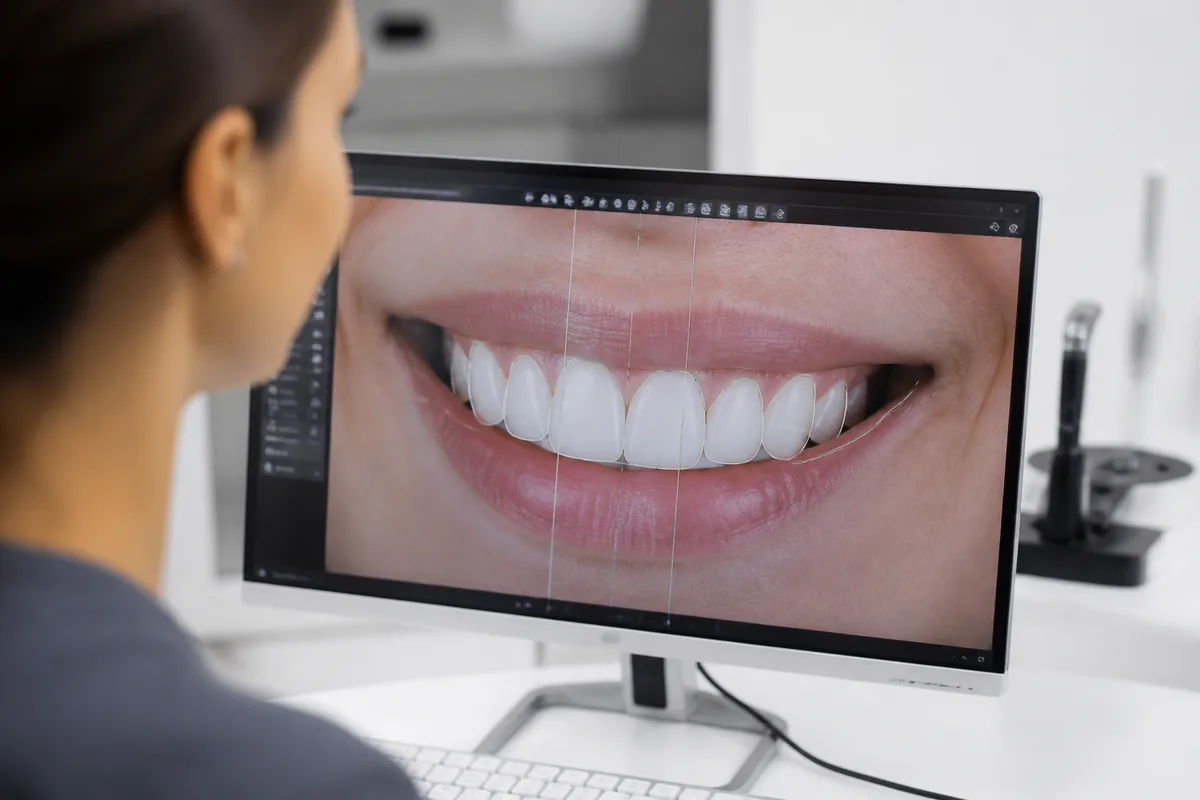
A comprehensive examination comes first, covering decay, gum health, the bite, and any grinding. Photographs, scans and sometimes a wax design of the proposed result are produced. From that design a mock-up can be placed directly over your unprepared teeth so you can see the shape in your own mouth and approve or change it before anything is cut.
At the preparation visit, the teeth are reduced according to the approved design, a scan or impression is taken, and temporary veneers are made from the same design. The temporaries are the rehearsal: live with them, and tell us what you want different about the length, shape or the way they feel when you speak. Changes made at this stage are easy and free.
The laboratory fabricates the porcelain over one to three weeks. At delivery the veneers are tried in with a try-in paste to confirm shade, then bonded individually with resin cement, cured, and the excess cement removed carefully from the margins and between the teeth. The bite is refined and everything polished.
Porcelain versus composite veneers
Composite veneers are built directly onto the teeth in one visit from the same material used for bonding. They cost considerably less, need less or no tooth preparation, and are repairable chairside. They are a good option for younger patients, for people who want to trial a shape, and for budgets that do not stretch to porcelain.
Porcelain resists stain almost entirely, holds its polish for decades, has better optical depth, and lasts roughly twice as long. It also requires a laboratory, two or three visits, and irreversible preparation in most cases.
Neither is the correct answer in general. The question is what your teeth need, how long you want it to last, and what you can commit to maintaining.
Living with veneers
Brush and floss normally, including carefully between the teeth, because the tooth beneath the veneer and the gumline margin can still decay. That is the most common long-term failure, more common than the porcelain breaking.
Wear a night guard if you grind, avoid biting hard objects, and expect your hygienist to use a non-abrasive polishing paste at cleanings, since standard prophy paste can dull the glaze.
Published survival figures for porcelain veneers commonly show around ninety percent still in service at ten years, with many lasting considerably longer. If you are considering a smile change, come in for an evaluation and a mock-up before committing to anything irreversible. Call Cedar Creek Dentistry in Portland.
Questions about your own care? The team at The Best Dentist In Portland, Oregon is happy to help — call us at (503) 646-1811.
This article is for general information only and is not medical advice.