Our Services
Professional Teeth Cleanings: What They Do and Why They Matter
A cleaning is the appointment people most often think of as optional when life gets busy. It is also the single most cost-effective thing in dentistry. The work done in that chair removes deposits that no toothbrush can touch and interrupts a disease process that is silent until it is expensive.
Knowing what a hygienist is actually doing, and why some of it cannot be replicated at home no matter how diligent you are, makes the visit easier to prioritize.
Plaque, tartar, and the line between them
Plaque is a living film of bacteria that reforms on your teeth within hours of being removed. It is soft, and you can brush and floss it away. That is the entire purpose of home care, and when it is done well and consistently, most of the mouth stays healthy.
The problem is that no one removes all of it. Minerals in your saliva harden whatever plaque is left into calculus, commonly called tartar, and this can begin within a couple of days. Tartar is a hard, porous deposit bonded to the tooth surface. Brushing does not remove it, flossing does not remove it, and no rinse dissolves it.
Tartar matters not because of the deposit itself but because its rough surface holds more plaque against the gumline and below it, where your toothbrush was never going to reach. That is where gum inflammation starts and where the professional instruments earn their keep.
What happens during the appointment
Most cleanings start with an examination of your gum tissue and, at appropriate intervals, measurement of the space between gum and tooth around each tooth. These numbers are the reason a hygienist sometimes tells you things look different this year even though nothing hurts.
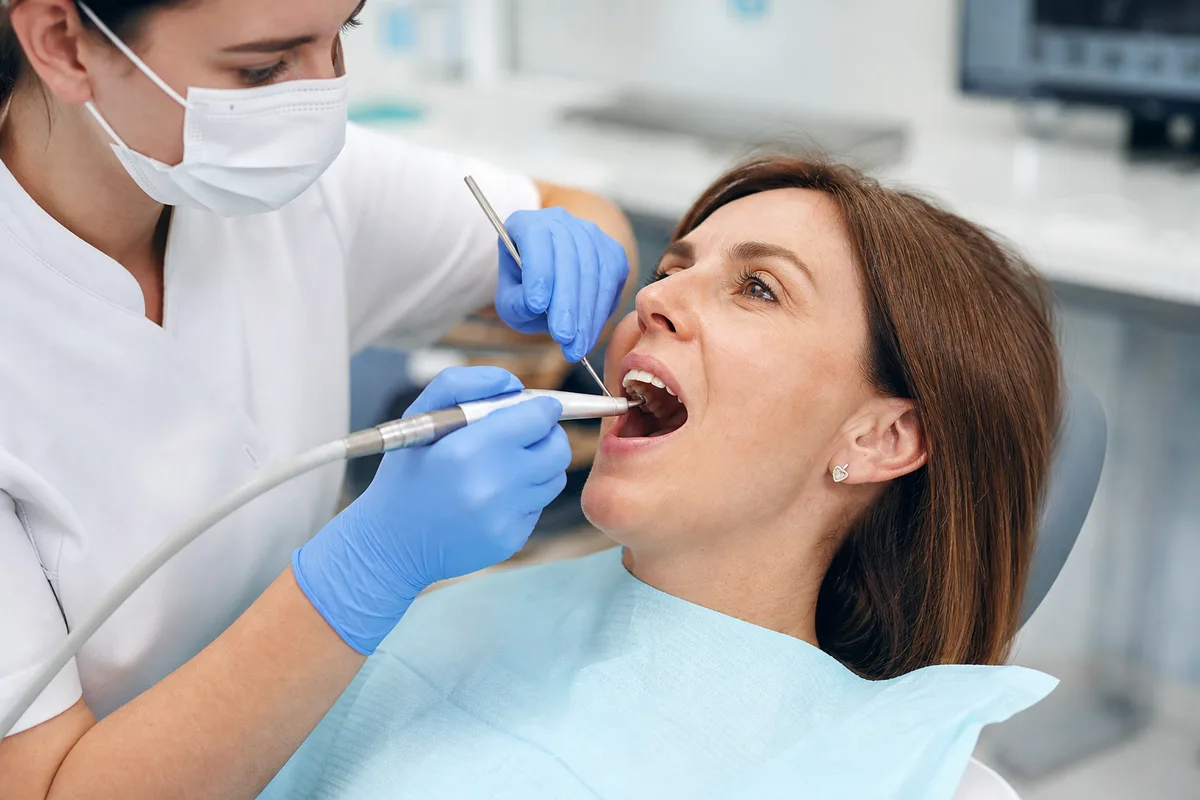
Deposits are then removed with a combination of ultrasonic instruments, which use high-frequency vibration and a water spray to break up larger accumulations, and hand instruments that finish the surfaces and reach detail the ultrasonic tip cannot. Above and just below the gumline are both cleaned, which is why the sensation differs from anything you do at home.
Polishing follows, with a paste that removes surface stain and leaves the enamel smooth so plaque takes longer to re-establish. Many visits finish with floss, and often a fluoride varnish for patients with elevated decay risk. A hygienist will also tell you where you are consistently missing, which is more useful than any general advice about technique.
Why it sometimes feels different than last time
Sensitivity during a cleaning usually has a cause worth naming. Inflamed gum tissue is tender and bleeds easily, and inflammation is a response to plaque left along the gumline, so a longer gap between visits or a stretch of rushed brushing commonly explains it. As the tissue heals over the following weeks, the next cleaning is generally more comfortable.
Exposed root surfaces from gum recession are also sensitive, because root is not covered by enamel. Tell your hygienist. Topical anesthetic, a gentler instrument selection, or a desensitizing agent applied afterward all help, and none of them compromise the cleaning.
If deposits have built up below the gumline and pockets have deepened, a routine cleaning is no longer the right treatment and scaling and root planing is recommended instead. That is a different procedure with a different purpose, not an upsell of the same one.
The connection to the rest of your body
Gum disease is a chronic inflammatory condition, and the inflammation does not stay politely in your mouth. Research over the past two decades has consistently linked periodontal disease with cardiovascular disease, poorly controlled diabetes, respiratory infections, rheumatoid arthritis, and complications in pregnancy.
Causation is complicated and still being studied, but the association is strong and the practical conclusion is simple. Controlling gum inflammation is a reasonable thing to do for reasons well beyond keeping your teeth, and for people managing diabetes the relationship runs in both directions: better gum health tends to make blood sugar easier to control.
How often you actually need one
Every six months suits most people with healthy gums and a low rate of decay. It roughly matches how long it takes for tartar to accumulate to a meaningful degree and for a new problem to become visible but still small.
A three or four month interval is standard for anyone with a history of periodontal disease, because the bacterial population in treated pockets repopulates on approximately that timeline. Smokers, people with dry mouth from medication, people with diabetes, orthodontic patients, and anyone with a heavy tartar-forming tendency also tend to do better on a shorter cycle.
If it has been a long time and you are reluctant to come in because you expect a lecture, come in anyway. We see this often and the appointment is a starting point, not a judgment. Call Cedar Creek Dentistry in Portland and we will make the first visit straightforward.
Questions about your own care? The team at The Best Dentist In Portland, Oregon is happy to help — call us at (503) 646-1811.
This article is for general information only and is not medical advice.