Our Services
Restorative Dentistry: Rebuilding a Damaged Smile
Restorative dentistry is the umbrella term for everything that repairs or replaces damaged and missing teeth. It runs from a small filling to rebuilding an entire mouth, and the treatments are best understood as a ladder rather than a menu.
Each rung addresses a certain amount of lost structure. Choosing the right rung, neither under-treating a tooth that will then fracture nor over-treating one that did not need it, is most of the skill.
The ladder, from least to most
A filling replaces a small to moderate amount of structure and relies on the surrounding tooth for support. An inlay or onlay, made in the laboratory or milled chairside, covers more area and can protect a weakened cusp without covering the whole tooth. A crown covers the entire tooth and holds the remaining walls together.
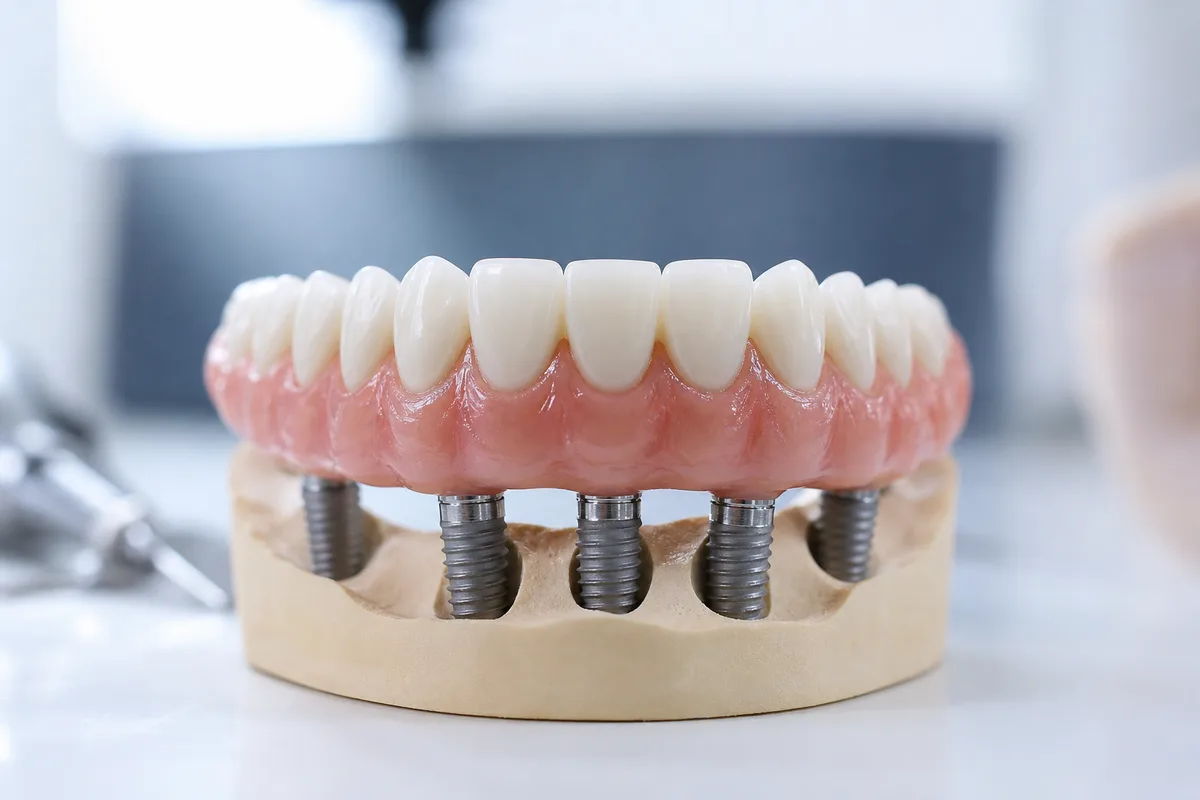
When a tooth cannot be saved, replacement begins. A bridge spans the gap using the neighboring teeth as supports. An implant replaces the root itself with a titanium post in the bone and carries its own crown, without involving the adjacent teeth. A partial denture replaces several teeth removably; a complete denture replaces a full arch.
Running alongside all of this is root canal treatment, which is not a restoration but is often the prerequisite for one when the nerve of a badly damaged tooth is involved.
Why the right rung matters
The most common and most costly mistake in restorative dentistry is placing another large filling in a tooth whose walls are already thin. It is cheaper today and it frequently ends with a cusp splitting off, sometimes below the gumline, which turns a crownable tooth into an extraction.
The opposite error is real too. Crowning a tooth that only needed a modest filling removes healthy structure and starts a restoration cycle earlier than necessary. A tooth that has been crowned will be re-crowned, and each cycle costs more tooth.
The useful question to ask about any recommendation is what specifically makes the smaller option inadequate here. There should be a concrete answer: an undermined cusp, a visible crack line, a missing wall, a root-canal-treated molar.
Sequencing a larger case
When there is a lot to do, the order is not arbitrary. Anything actively infected or painful comes first, then active decay is stabilized, sometimes with temporary restorations placed quickly across several teeth so the disease stops progressing while the definitive plan is worked out.
Gum health is addressed before permanent restorations, because margins placed against inflamed, bleeding tissue will not seal well and because it makes no sense to crown a tooth whose support is being lost. Extractions of hopeless teeth happen early, with bone grafting at the time of removal if implants are planned, since waiting costs bone volume.
Then the bite is established, restorations are built to it, and replacement of missing teeth follows. Cosmetic refinement comes last. This ordering is why a comprehensive plan sometimes looks slower at the start than a piecemeal approach, and why it produces a better result.
Prioritizing when budget is the constraint
Most people do not do everything at once, and a plan that ignores that is not a plan. A reasonable set of priorities looks like this: treat pain and infection now; stabilize active decay next, because it spreads and gets more expensive monthly; then protect teeth at genuine risk of fracture; then replace missing teeth; then address cosmetic concerns.
Ask which items are urgent, which are important but stable for six to twelve months, and which are elective. A good treatment plan can be divided into phases with a clear explanation of what deteriorates if a phase is delayed and what genuinely does not.
Also ask about insurance annual maximums, because splitting a large case across two benefit years is often straightforward and saves real money. Payment plans and third-party financing are worth discussing openly rather than assuming they do not exist.
Keeping the work you paid for
Restorations fail for three main reasons: new decay at the margins, fracture from grinding, and gum disease undermining support. All three are substantially controllable.
That means daily cleaning between the teeth with genuine attention to the margins of crowns and bridges, a night guard if you grind, professional cleanings at an interval matched to your risk rather than a default, and coming in when something feels different rather than waiting for the next scheduled visit.
If you have been putting off a mouth that needs significant work because you do not know where to start, a comprehensive examination and a phased written plan is the place to begin. Call Cedar Creek Dentistry in Portland.
Questions about your own care? The team at The Best Dentist In Portland, Oregon is happy to help — call us at (503) 646-1811.
This article is for general information only and is not medical advice.