Our Services
Root Canal Treatment: What Endodontics Really Involves
Root canal treatment has a reputation that is roughly forty years out of date. It is the procedure people cite as the benchmark for an unpleasant experience, and in current practice, with modern anesthesia and rotary instrumentation, it is comparable to having a large filling placed.
More importantly, it is not the cause of the pain. It is the treatment for it. The pain that brings people in is caused by inflamed or infected nerve tissue trapped inside a rigid tooth, and the procedure removes it.
What is actually inside a tooth
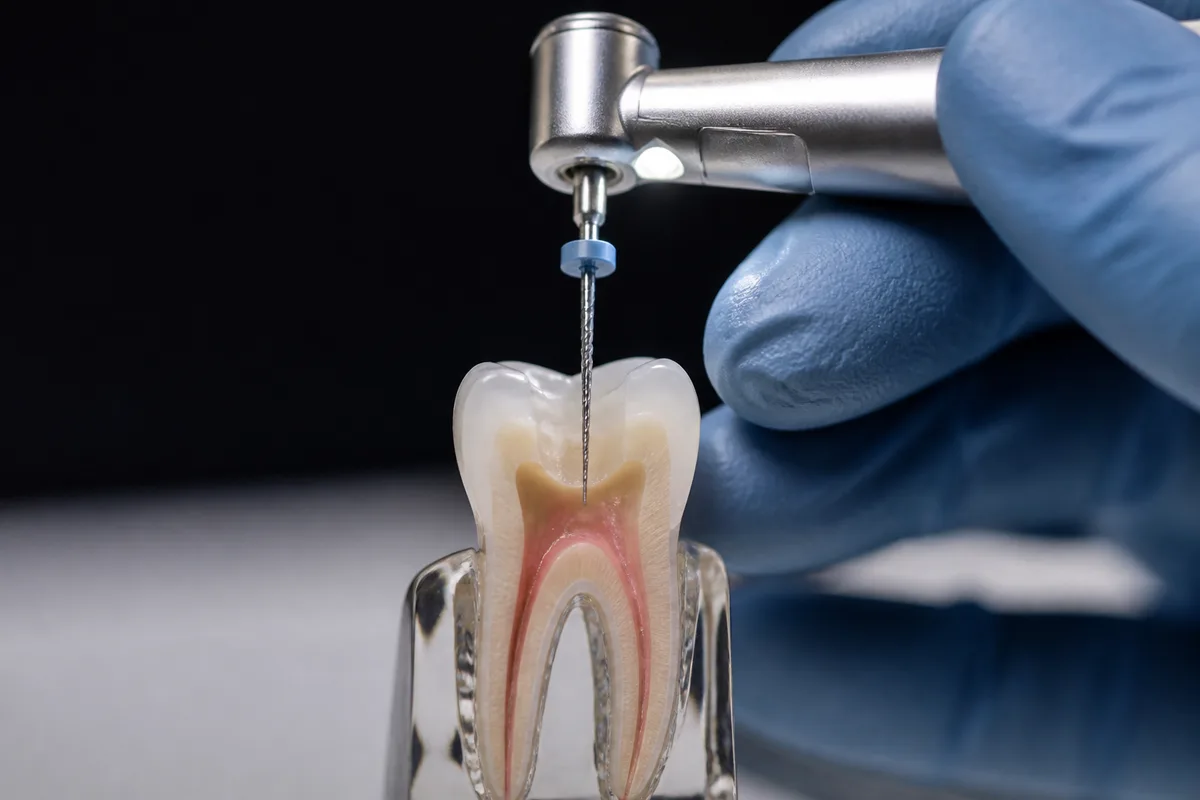
Beneath the enamel and dentin, every tooth has a hollow chamber running down through each root, containing the pulp: nerve fibers, blood vessels, and connective tissue. The pulp forms the tooth during development and provides sensation and a limited repair response afterward. A fully developed tooth does not need it to function.
When bacteria reach the pulp, through deep decay, a crack, a fracture, repeated dental work on the same tooth, or trauma, the tissue becomes inflamed. Because it is sealed inside unyielding walls, the swelling has nowhere to expand and pressure builds against the nerve. That is the character of classic root canal pain: deep, throbbing, worse lying down, poorly localized, and often triggered severely by heat.
Left alone, the pulp dies. The pain may disappear entirely for a while, which many people take as recovery. It is not. Bacteria continue to multiply in the dead tissue and eventually exit through the root tip into the bone, forming an abscess that appears on an X-ray as a dark area and can flare into significant facial swelling.
The procedure, step by step
The tooth is anesthetized thoroughly. An infected tooth can be harder to numb, so additional techniques are used and we confirm you are comfortable before starting. A rubber dam isolates the tooth, keeping it dry and keeping irrigating solutions away from the rest of your mouth.
A small access opening is made through the biting surface. The canals are located, measured to their exact length with an electronic apex locator, and shaped with fine flexible nickel-titanium files driven by a controlled handpiece. Throughout, the canals are irrigated with disinfecting solution, which does much of the actual cleaning, particularly in the irregular side branches that files cannot reach.
Once cleaned and dried, the canals are filled with gutta-percha, a rubber-like material, and sealer, so bacteria have no space to recolonize. The access opening is sealed, and the tooth is restored, typically with a crown for back teeth. Many cases are completed in a single appointment; some are done over two.
Afterward
Mild to moderate tenderness when biting for a few days is expected, as the ligament around the root is irritated. Over-the-counter anti-inflammatory medication handles it well for most people. The severe, spontaneous pain that preceded treatment should be gone.
Avoid chewing on the tooth until it has its permanent restoration. A tooth with a temporary filling and an access opening through the middle is structurally vulnerable, and a fracture at this stage can render the whole effort pointless.
The single most important thing you can do is return for the final crown promptly. Teeth that sit for months with only a temporary seal are the ones that fail, either from leakage that reinfects the canals or from a fracture.
Success rates and the alternative
Root canal treatment succeeds in roughly ninety to ninety-five percent of cases when the tooth is properly restored afterward. Success means the infection resolves, the bone around the root tip heals, and the tooth functions normally for years or decades.
When treatment does not fully succeed, options remain. Retreatment, in which the original filling material is removed and the canals re-cleaned, resolves many cases. An apicoectomy, a small surgical procedure at the root tip, addresses others.
The alternative to treatment is extraction, followed by an implant or bridge if the space is to be restored. That is a legitimate choice in some situations, particularly a tooth with a vertical root fracture or too little remaining structure. But a natural tooth root maintains bone, retains the ligament that gives you fine sensory feedback when chewing, and costs less overall than removal plus replacement. Keeping your own tooth is usually the better outcome.
What does not require a root canal
Brief cold sensitivity that disappears within a few seconds is usually not pulp disease. Sensitivity from exposed roots, a recently placed deep filling, or a high bite often settles on its own or with a simple adjustment.
The signals that point toward the pulp are lingering pain after hot or cold, spontaneous pain, pain that wakes you at night, pain on biting combined with a swollen gum, a pimple-like bump on the gum that drains, or a tooth that has darkened.
If any of that sounds familiar, do not wait for it to stop hurting. Call Cedar Creek Dentistry in Portland, because the window where this is a straightforward procedure is now.
Questions about your own care? The team at The Best Dentist In Portland, Oregon is happy to help — call us at (503) 646-1811.
This article is for general information only and is not medical advice.