Our Services
Tooth Extractions: When a Tooth Has to Come Out
Removing a tooth is the last option in a field built around keeping teeth. When it is recommended, it is because the alternatives have been weighed and found to be worse, either for the tooth itself or for everything around it.
Extraction has also changed considerably. Anesthesia is more effective, techniques are more conservative, and the planning now routinely includes what will fill the space afterward rather than treating the removal as the end of the story.
Why a tooth gets removed
Decay that has destroyed so much of the tooth that nothing restorable remains above or just below the gum is the most common reason. A tooth needs enough sound structure for a restoration to hold onto, and below a certain point there is nothing to build on.
Advanced periodontal disease is the second major cause. When the bone that supports a tooth has been lost, the tooth loosens, and no filling or crown addresses a foundation problem. A vertical fracture running down the root is similar: the crack cannot be repaired and it provides a permanent path for bacteria.
Other reasons include impacted wisdom teeth causing damage or infection, teeth removed to relieve crowding as part of orthodontic treatment, failed root canal treatment that cannot be redone or surgically retreated, and severe infection that has not responded to treatment. In children, a stubborn baby tooth blocking a permanent one sometimes needs help out of the way.
Simple versus surgical
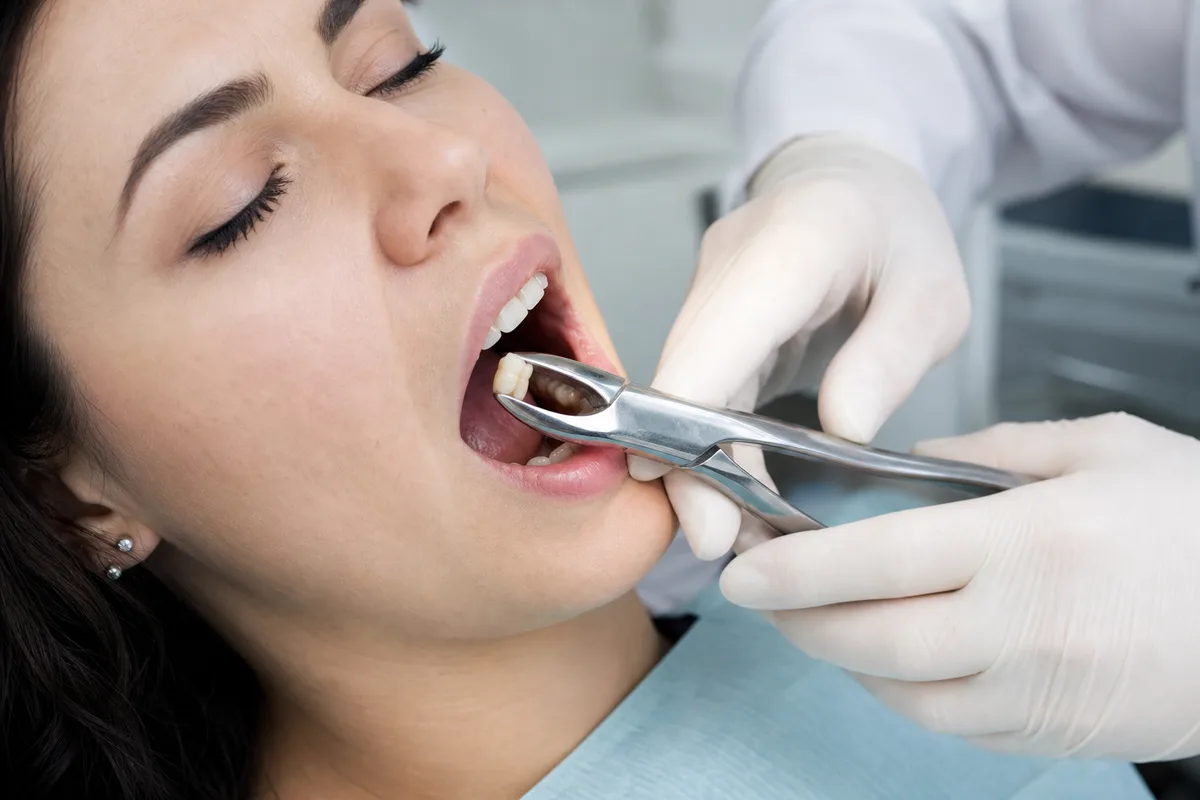
A simple extraction applies to a tooth fully visible above the gumline with a reasonably straightforward root shape. The tooth is loosened in its socket with an instrument that widens the ligament space, then removed with forceps. It is done with local anesthetic and often takes only a few minutes. You should feel pressure, which is unavoidable, but not sharp pain.
A surgical extraction is needed when the tooth is broken at the gumline, impacted, or has curved or divergent roots. The dentist makes a small incision to access the tooth, may remove a small amount of bone, and often sections the tooth into pieces so each root can be removed along its own path. Sectioning sounds more aggressive and is usually the gentler approach, because it avoids stressing the surrounding bone.
Sutures may be placed afterward, frequently the dissolving kind. Sedation options beyond local anesthetic are available for longer surgical cases or for anyone who finds the prospect stressful.
Recovery, honestly
The first twenty-four hours are the ones that matter. A blood clot forms in the socket and is the foundation for everything that heals afterward. Bite firmly on gauze for thirty to sixty minutes, do not rinse vigorously, do not spit forcefully, do not drink through a straw, and do not smoke. Each of these can dislodge the clot.
Expect some oozing for several hours, swelling that peaks around day two or three, and discomfort that is generally well managed with over-the-counter medication. Ibuprofen and acetaminophen taken together on a schedule are, for most people, more effective than a narcotic for dental pain. Use ice on the outside of the face for the first day and warm compresses afterward.
Eat soft, cool foods for the first day or two, chew on the other side, and keep your mouth clean by brushing the rest of your teeth normally and rinsing gently with warm salt water beginning the day after. Soft tissue closes over within a few weeks and the bone underneath fills in over several months.
Dry socket and other complications
Dry socket occurs when the clot is lost or fails to form, leaving bone exposed. It typically announces itself on day three to five with a deep, throbbing ache that often radiates toward the ear and is markedly worse than the day before. Smokers and people taking oral contraceptives are at higher risk, and lower molars are the most common site.
It is not an infection and it is treated easily: the socket is gently irrigated and a medicated dressing placed, which usually brings substantial relief within an hour. Call rather than waiting it out.
Signs that warrant a call include bleeding that has not slowed after several hours of firm pressure, swelling that increases after day three rather than improving, fever, difficulty swallowing or opening your mouth, or numbness that persists well beyond the expected duration of the anesthetic.
Planning for the space
Once a tooth is gone, the bone that held it begins to resorb, most rapidly in the first six months. Neighboring teeth drift toward the gap and the opposing tooth can over-erupt into it, which changes your bite and makes later replacement more complicated.
This is why the replacement conversation should happen before the extraction, not a year later. A socket preservation graft placed at the time of removal maintains bone volume and keeps implant placement straightforward. Implants, bridges, and partial dentures each suit different situations.
Back molars are sometimes reasonably left unreplaced, depending on your bite. That is a judgment call worth making deliberately. If you have a tooth you have been told needs to come out, call Cedar Creek Dentistry in Portland and let us walk through both the removal and what comes after.
Questions about your own care? The team at The Best Dentist In Portland, Oregon is happy to help — call us at (503) 646-1811.
This article is for general information only and is not medical advice.