Our Technology
Apex Locators: Measuring the Root Canal Precisely
The single most important measurement in root canal treatment is working length: exactly how far down each canal the instruments and the filling should go. Too short and infected tissue is left behind. Too long and instruments push through the end of the root into bone.
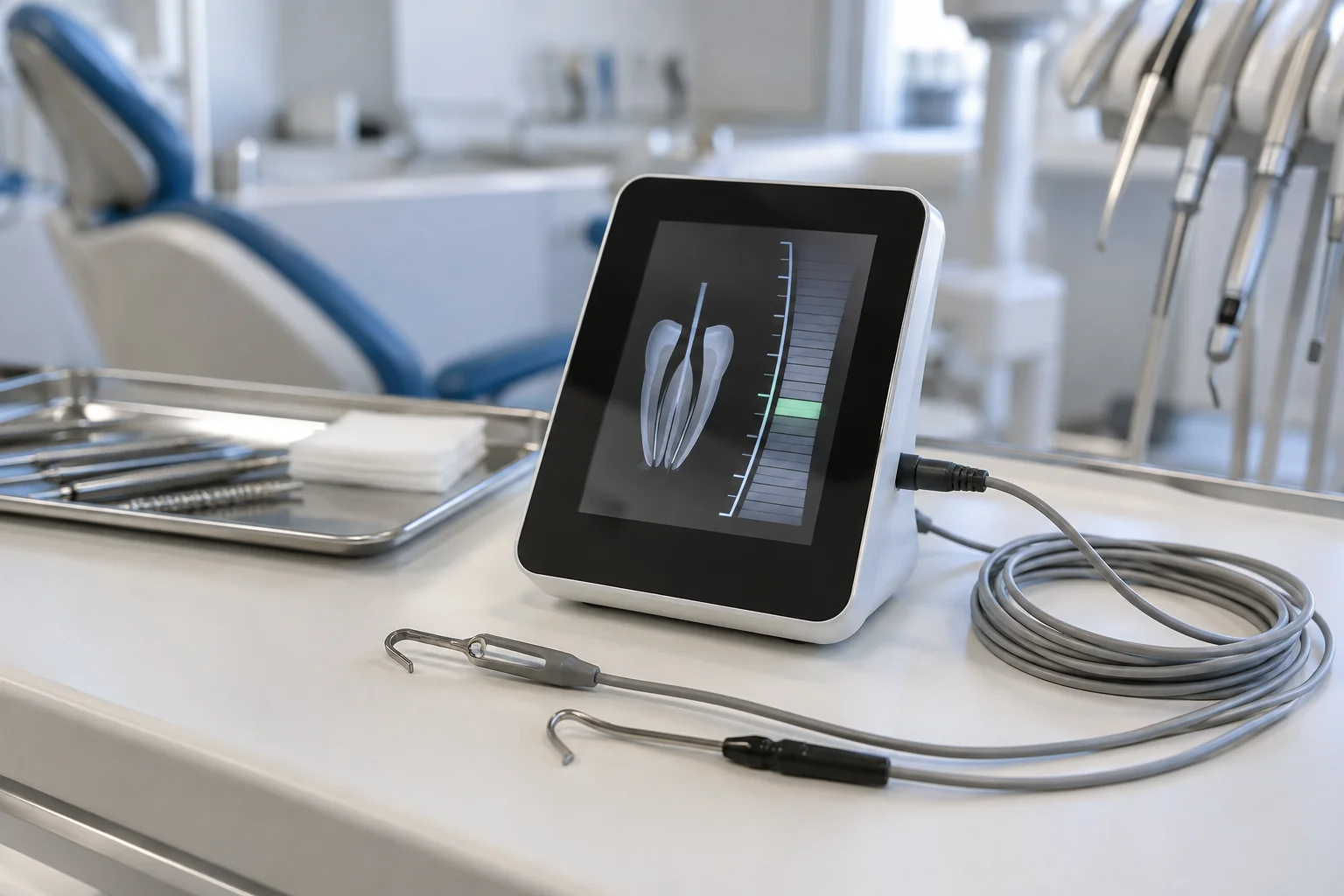
An electronic apex locator determines that length by measuring electrical characteristics inside the canal. It is a small device with a lip clip and a file holder, and it is the reason modern endodontics is far more accurate than it used to be.
Why the end of the root is not where you think
The target is not the tip of the root as it appears on an X-ray. It is the apical constriction, the narrowest point of the canal, which sits slightly short of the anatomical tip. Beyond it, the canal widens again and opens into the ligament and bone.
That constriction is the natural stopping point: filling to it seals the canal system, while filling past it places material in tissue that will react to it. The distance involved is small, often well under a millimeter, which is why guessing is not good enough.
The opening at the end of the root is also frequently not at the anatomical tip at all. It commonly exits to one side, and there are often several small openings rather than one. None of that is reliably visible on a two-dimensional image.
How the measurement works
A lip clip completes a circuit through your body, and a file introduced into the canal is connected to the other terminal. As the file advances, the electrical impedance between the file tip and the lip clip changes in a characteristic way, and it changes sharply as the tip reaches the constriction and the surrounding tissue.
Modern units measure at multiple frequencies simultaneously and compare the results, which makes them far more reliable than early single-frequency devices in the presence of blood, pus, irrigating solution or pulp tissue. Accuracy in clinical studies is consistently reported above ninety percent.
The reading is displayed on screen and usually accompanied by an audible tone as the file approaches length. Many endodontic motors integrate the locator, so the motor slows or stops the file automatically as it nears the measured length.
Why not just use X-rays
X-rays are still taken, and the two methods are used together. But a radiograph is a flat projection of a three-dimensional object, so a canal that curves toward or away from the film is foreshortened or elongated, and two canals in the same root superimpose on each other.
It also cannot show the apical constriction, which is a soft-tissue landmark, only the radiographic tip of the root. And a working-length radiograph means an additional exposure, sometimes several if the first file is not at the right length.
Electronic measurement is taken continuously, in real time, with no radiation, and it can be rechecked at any point during the procedure, which matters because the reference point can shift as the canal is shaped. The standard of care is to use the apex locator as the primary determinant and confirm radiographically.
What it means for the outcome
Accurate length is directly associated with success. Root canal treatments filled to an appropriate length have measurably better long-term outcomes than those filled significantly short or long.
It also affects how you feel afterward. Instrumenting or filling past the end of the root irritates the ligament and is a common cause of post-operative tenderness, so accurate length generally means a more comfortable few days.
Fewer radiographs, a shorter appointment, and a more predictable result are the practical effects. If you are having root canal treatment, this is one of the quiet pieces of equipment doing a lot of the work. Call Cedar Creek Dentistry in Portland if you have questions about a tooth that needs treatment.
Questions about your own care? The team at The Best Dentist In Portland, Oregon is happy to help — call us at (503) 646-1811.
This article is for general information only and is not medical advice.