Our Technology
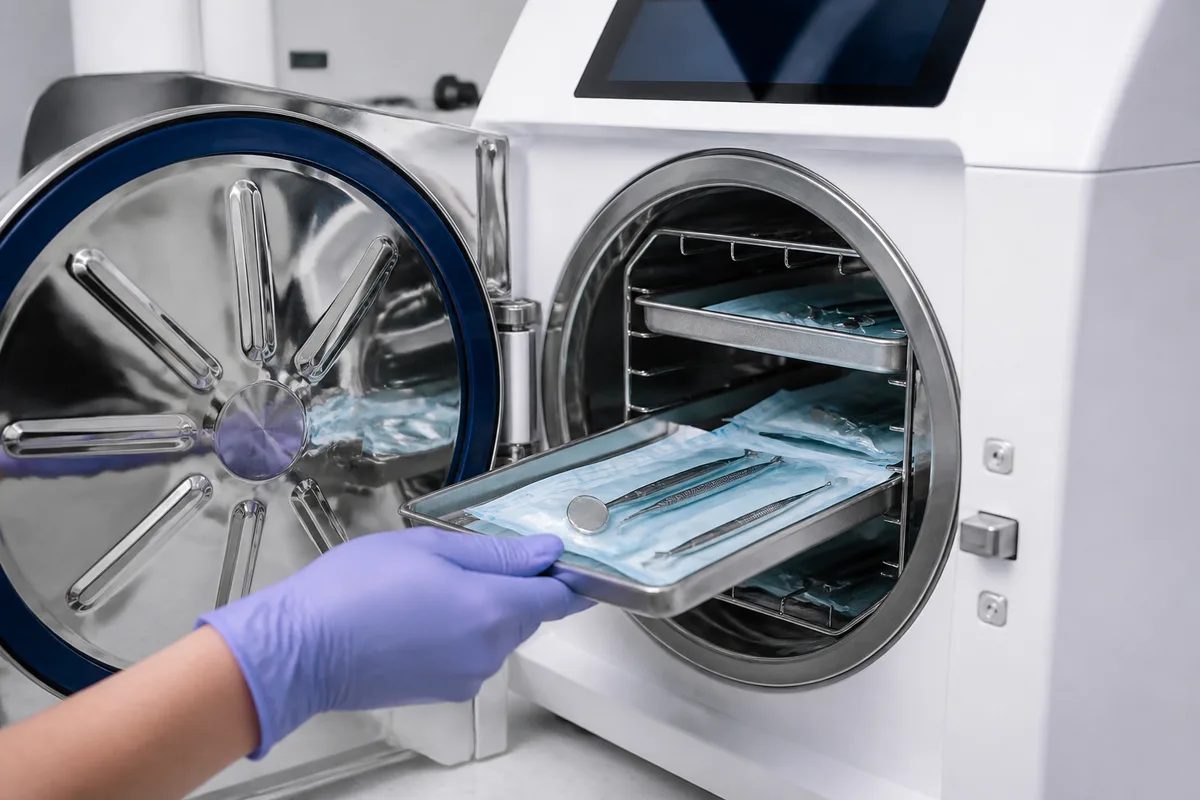
Autoclave Sterilization: How Instruments Are Made Safe
Sterilization is the part of a dental visit nobody sees and everybody assumes. It happens in a dedicated room behind the operatories, and it follows a sequence that is the same in every well-run practice because the standards behind it are not optional.
The short version: every instrument that touches you is either single-use and discarded, or steam-sterilized at high temperature and pressure, sealed in a pouch, and tested weekly against a biological challenge designed to be harder to kill than anything that could come off an instrument.
What an autoclave actually does
An autoclave sterilizes with saturated steam under pressure. Water alone boils at 100 degrees Celsius, which is not hot enough to reliably destroy bacterial spores. Raising the pressure inside a sealed chamber raises the boiling point, so the steam reaches roughly 121 to 134 degrees Celsius.
Steam, not dry heat, is what makes it work. Moist heat denatures proteins far more efficiently than dry heat at the same temperature, and pressurized steam penetrates into hinges, hollow handpieces and the folds of a wrapped pouch. A typical cycle holds instruments at temperature for several minutes, then dries them before the door is opened.
Sterilization is an absolute standard, not a strong cleaning. It means the destruction of all microbial life including bacterial spores, which are the most heat-resistant biological structures known. Disinfection, which is what surface wipes achieve, is a lower bar and is the correct standard for countertops and chairs, not for instruments.
The full processing cycle
Instruments are transported from the operatory in a closed container to a dedicated processing area with a one-way flow from dirty to clean, so contaminated items never cross paths with sterilized ones.
Cleaning comes first and matters enormously, because debris left on an instrument can shield organisms from steam. Most practices use an ultrasonic cleaner or a washer-disinfector rather than hand scrubbing, both because it cleans more thoroughly into crevices and because it removes the sharps-handling risk of scrubbing by hand.
Cleaned instruments are inspected, dried, and packaged in pouches or cassette wraps carrying a chemical indicator. They are loaded into the autoclave without overpacking, since steam has to circulate around every surface. After the cycle, packages are checked for dryness and for the indicator change, then stored sealed. The pouch is what maintains sterility until it is opened in front of you, which is why instruments arrive at the chair still sealed.
How we know a cycle actually worked
Three layers of monitoring are used, and they answer different questions. Mechanical monitoring is the printout or digital log of temperature, pressure and time for each cycle, confirming the machine reached and held its parameters.
Chemical indicators are the stripes or dots on the pouch that change color. An external indicator confirms a package was processed rather than accidentally skipped. An internal indicator confirms steam penetrated to the inside of the package. Neither proves sterility on its own.
Biological monitoring is the one that does. A test vial containing a measured population of highly heat-resistant bacterial spores is run through a normal cycle, then incubated. If nothing grows, the cycle destroyed organisms far tougher than anything that would be on an instrument. Weekly spore testing is the accepted standard, results are recorded, and a failed test means the autoclave is taken out of service until the cause is found and the load reprocessed.
Everything else in the chain
A great deal of what touches you is single-use by design: gloves, masks, needles, anesthetic cartridges, saliva ejectors, prophy angles, polishing cups, gauze, bibs, barrier sleeves and impression trays in many cases. They are opened in front of you and discarded afterward, and they are never reprocessed.
Handpieces, the drills, are heat sterilized between every patient rather than merely wiped down, because they draw back small amounts of fluid internally during use. Surfaces that cannot be sterilized, such as the chair, light handles, the X-ray sensor and the keyboard, are either covered with disposable barriers that are replaced between patients or disinfected with a hospital-grade product for the full contact time on its label.
Waterlines that feed the handpieces and the air-water syringe are treated and periodically tested, because untreated lines can develop a biofilm. If you are ever curious about how any of this is done here, ask us and we will show you the sterilization area. Call Cedar Creek Dentistry in Portland.
Questions about your own care? The team at The Best Dentist In Portland, Oregon is happy to help — call us at (503) 646-1811.
This article is for general information only and is not medical advice.