Our Technology
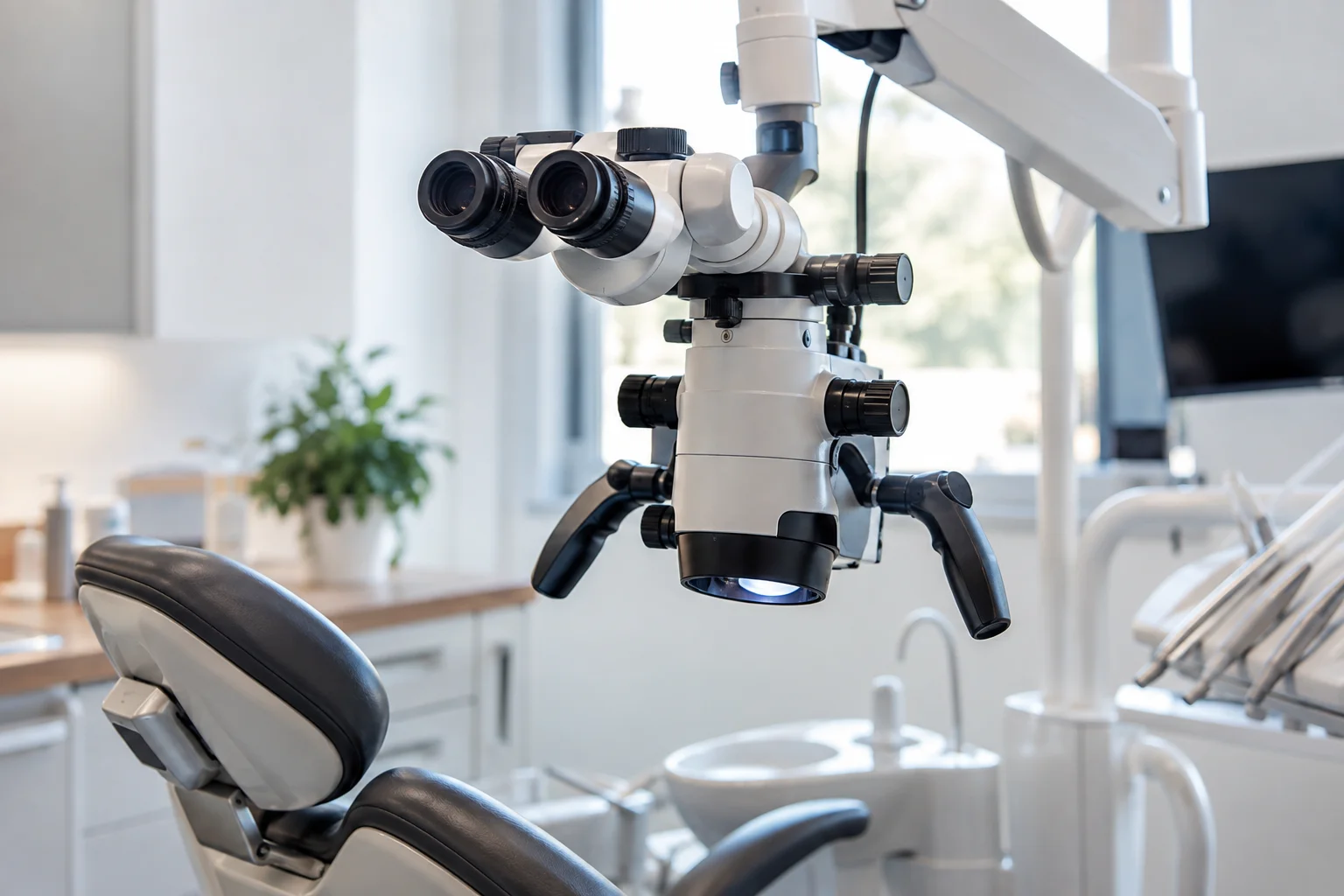
The Dental Operating Microscope
A dental operating microscope is the same class of instrument used in neurosurgery and ophthalmology, adapted for the mouth. It provides magnification from roughly three times up to twenty-five or thirty times, with a powerful light source aligned directly along the line of sight.
It sounds like an extravagance for working on teeth. In endodontics in particular it is closer to essential, because the structures involved are genuinely at the limit of what the unaided eye can resolve.
Magnification and light, and why both matter
The naked eye can resolve detail down to roughly two tenths of a millimeter at normal working distance. A calcified canal orifice, a hairline fracture, or the margin of a crown preparation can all be smaller than that. Magnifying loupes, the glasses-mounted magnifiers most dentists wear, typically give two to six times and are a large improvement.
A microscope goes considerably further, and crucially it offers variable magnification: low power for orientation, high power for the detail, switched during the procedure.
The light is at least as important as the magnification. A microscope's illumination is coaxial, travelling along the same axis as your line of sight, so it reaches the bottom of a narrow canal or a deep preparation without being blocked by the operator's own view. Any dentist who has tried to see into a molar canal with an overhead light understands the difference immediately.
Where it changes the outcome
Endodontics is the clearest case. Locating every canal is the single biggest factor in root canal success, and missed canals are a leading cause of failure. The second canal in the mesiobuccal root of an upper molar is present in the majority of teeth and is frequently missed without magnification.
It also allows calcified canals to be negotiated rather than abandoned, separated instruments to be retrieved, perforations to be identified and repaired precisely, and vertical root fractures to be seen directly, which often converts an uncertain prognosis into a clear decision.
In surgical endodontics it is the standard of care. An apicoectomy performed under a microscope, with the root end inspected at high magnification and sealed with a bioceramic material, has markedly better reported success rates than the same procedure done without.
Beyond root canals
Restorative work benefits directly. Crown and inlay margins can be finished and verified at magnification, and marginal fit is the main determinant of how long that restoration lasts before decay starts underneath it. Excess cement, which causes gum inflammation and is a known cause of problems around implants, is far easier to see and remove.
Cracked teeth are diagnosed more confidently, including whether a crack extends into the root, which determines whether the tooth is restorable at all. Caries removal becomes more conservative, because the boundary between decayed and sound dentin is visible rather than inferred.
Periodontal surgery, gum grafting and implant surgery all use it for precise incisions and suturing of delicate tissue, where the difference between an adequate and an excellent result is measured in fractions of a millimeter.
What it means from the chair
The microscope is mounted on an arm and positioned above you; nothing touches you and it adds no discomfort. Most units have a camera, so images and video of your own tooth can be captured and shown to you afterward, which is often the first time a patient actually sees the crack or the extra canal being described.
Procedures under a microscope are sometimes a little longer, because the operator is working slowly and deliberately at high magnification. That is generally a trade worth making.
It is a tool, not a guarantee, and it does not substitute for diagnosis, anesthesia, isolation or a well-made final restoration. But for complex endodontic work it removes a great deal of guesswork. If you have a tooth with a history of failed treatment or an unexplained problem, it is worth asking about. Call Cedar Creek Dentistry in Portland.
Questions about your own care? The team at The Best Dentist In Portland, Oregon is happy to help — call us at (503) 646-1811.
This article is for general information only and is not medical advice.