Our Technology
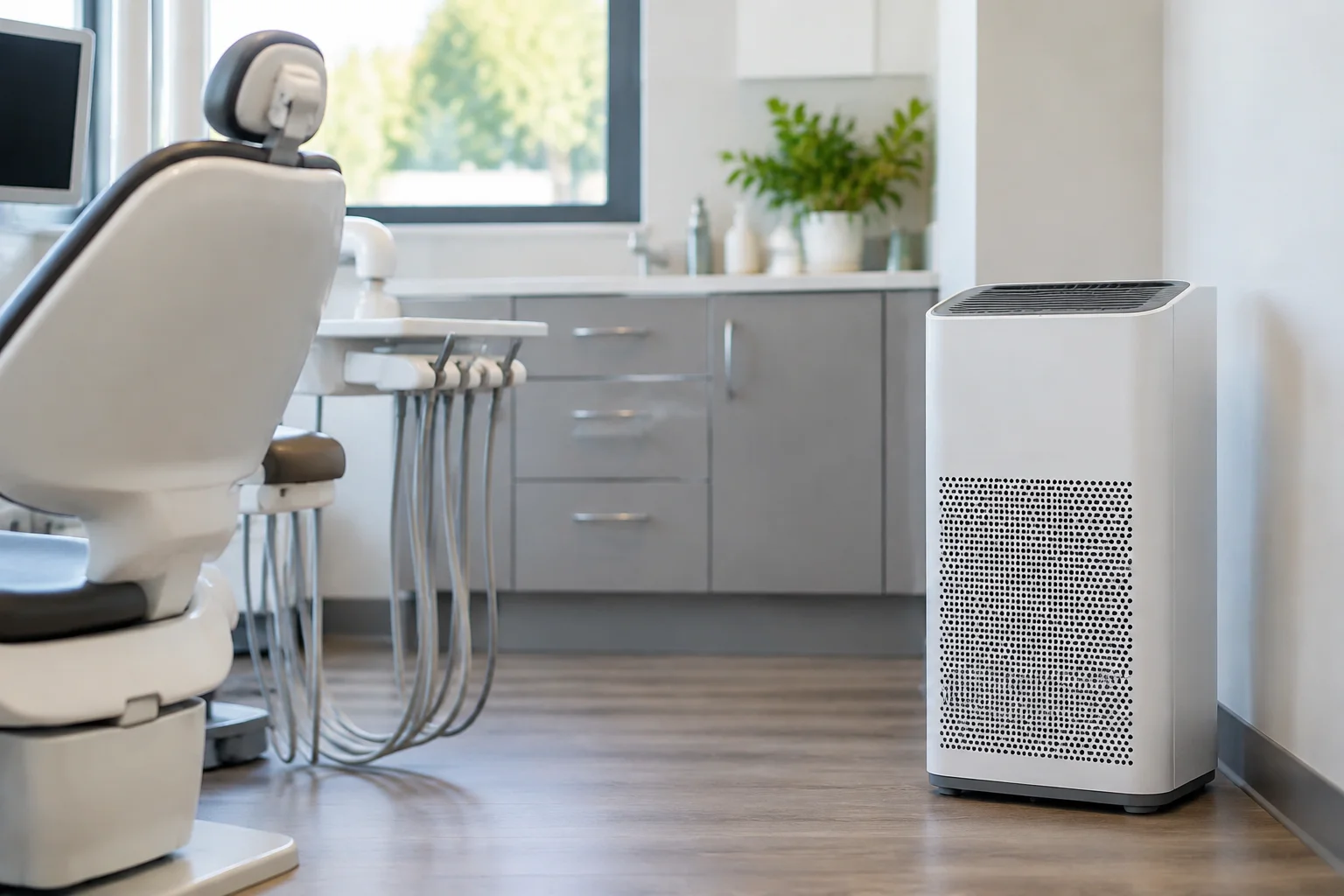
HEPA Air Purification in the Operatory
Dental procedures generate aerosols. Handpieces, ultrasonic scalers and air-water syringes all combine high-speed motion with water spray, and the result is a fine mist of water, saliva and particulate that can remain suspended in the air after the procedure ends.
Managing that air became a much more visible priority after 2020, and the equipment that does it has stayed. HEPA filtration in the operatory is now a normal part of infection control rather than an unusual addition.
What HEPA actually means
HEPA is a defined performance standard, not a marketing term. To be called a true HEPA filter, a filter must capture at least 99.97 percent of particles at 0.3 micrometers in diameter.
That particular size is specified because it is the hardest to catch. Larger particles are intercepted or collide with fibers directly; much smaller particles move erratically by diffusion and are captured easily. Around 0.3 micrometers is the point of minimum efficiency, so a filter rated there performs even better above and below it.
Beware of filters described as HEPA-type, HEPA-like or 99 percent efficient, which are not held to the standard. Many units also include a pre-filter for large particles and an activated carbon stage for odors and volatile compounds, which protects the HEPA element and extends its life. Some add ultraviolet treatment, which is a supplement rather than a substitute for mechanical filtration.
Air changes, and why the number matters
The measure that matters in a treatment room is air changes per hour: how many times the full volume of air in the room is filtered or replaced in an hour. It determines how quickly airborne particles are cleared after a procedure.
The relationship is not linear but it is straightforward: higher air changes mean a shorter interval before the room is effectively clear. A room relying on building ventilation alone may achieve only a few air changes per hour, while adding a properly sized portable HEPA unit can raise the effective rate substantially.
Sizing matters. A unit rated for a large open space will underperform if placed badly, and one rated for a small bedroom will not do much in an operatory. Placement close to the source, with the intake positioned to capture the plume rather than pull it across the room, is part of using them properly.
The other half: capturing aerosol at the source
Room filtration is the second line of defense. The first is stopping aerosol from becoming airborne at all, and that is a suction problem.
High-volume evacuation held close to the working area removes the large majority of spray before it disperses. Extraoral suction units, the articulated arms with a wide intake positioned near the patient's mouth, capture what escapes intraoral suction and filter it before returning the air to the room.
A pre-procedural antimicrobial rinse reduces the microbial load in whatever aerosol is produced. Rubber dam isolation, used routinely for restorative and endodontic work, dramatically reduces contamination of the spray by saliva. Together these measures address the source, and the HEPA unit handles the remainder.
What it means for your visit
There is a background hum. That is the main thing patients notice, and if it bothers you, headphones are available.
Beyond that, the benefit is passive: cleaner air in the room during and between appointments, and a shorter interval needed between patients for the room to clear. Filtration also removes ordinary airborne particulates, so it helps people with allergies or asthma who find clinical environments uncomfortable.
Filters need replacing on schedule to keep working; a loaded filter restricts airflow and reduces the effective air change rate. If you have questions about infection control here, or specific health concerns that make air quality important to you, tell us when you book. Call Cedar Creek Dentistry in Portland.
Questions about your own care? The team at The Best Dentist In Portland, Oregon is happy to help — call us at (503) 646-1811.
This article is for general information only and is not medical advice.