Our Technology
High-Powered Suction: Comfort and Safety in One Tool
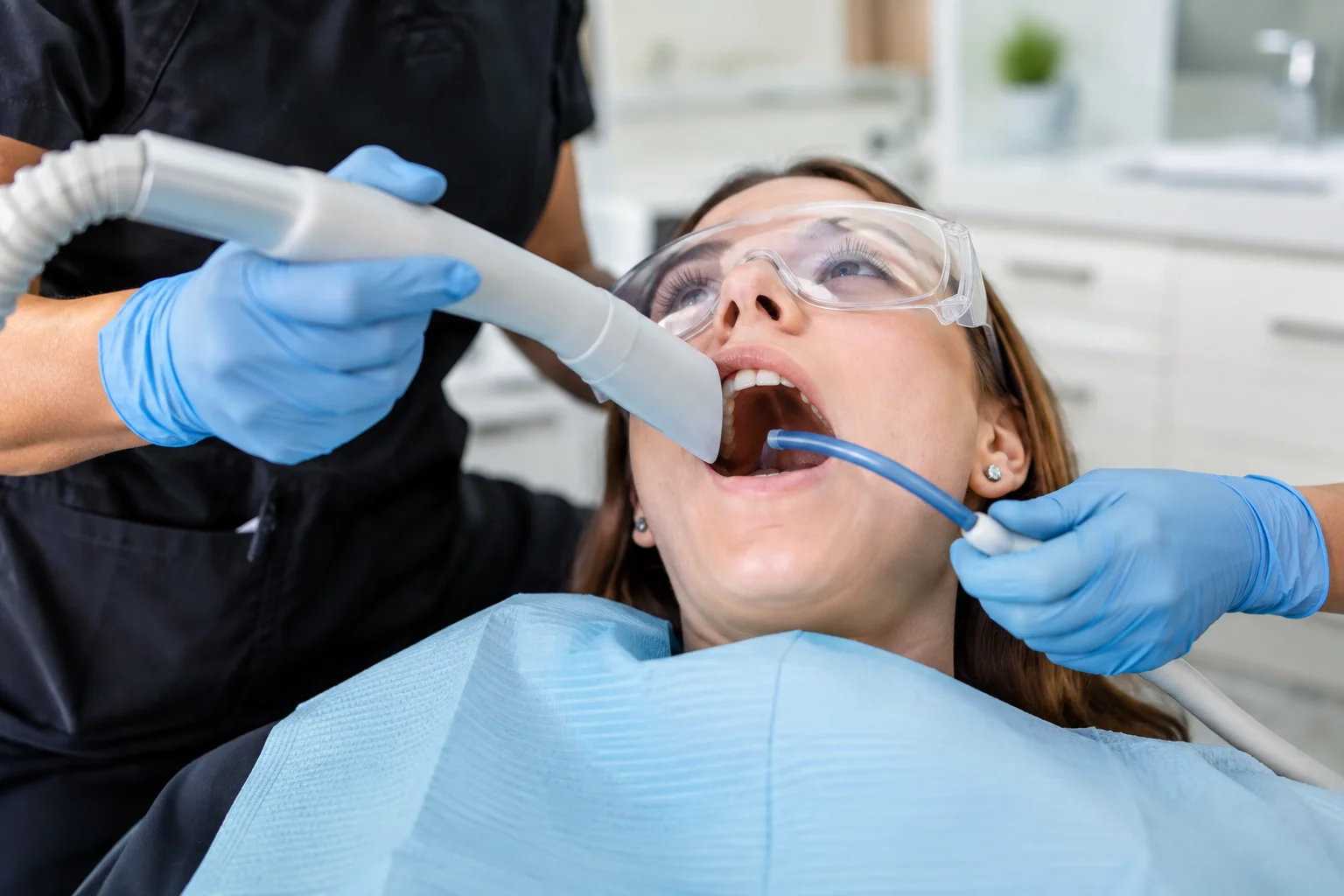
Suction is the piece of equipment patients notice constantly and think about least. It is the reason you can lie back through a procedure involving continuous water spray without choking, and it does considerably more than keep you dry.
There are two distinct systems, and the difference between them explains a lot about how an appointment feels.
Two kinds of suction, two jobs
The saliva ejector is the thin, flexible plastic tube, often with a small perforated tip, that hooks over your lower lip. It runs at low volume and its job is passive: continuously drawing off pooled saliva and water so the floor of your mouth does not fill up. It is what allows you to keep your mouth open for long stretches without swallowing.
High-volume evacuation is the wide rigid tip held by the assistant. It moves a very large volume of air per minute, which is a different order of magnitude from the saliva ejector, and it is actively positioned near the working field rather than parked.
That volume of airflow is what captures the spray from a handpiece or an ultrasonic scaler at the moment it is created. It is also what keeps debris, water and small fragments from reaching the back of your throat.
Why it matters clinically
Visibility first. Restorative dentistry depends on a dry, clean field: composite bonding fails if the tooth surface is contaminated with saliva or blood during placement, cements do not set properly in moisture, and a preparation margin cannot be judged if it is under water. A significant share of restoration failures trace back to moisture control during placement.
Airway protection second. High-volume suction catches fragments of old filling material, tooth structure, and small instruments before they travel. This is one reason a rubber dam is used for restorative and endodontic work, and why suction is positioned deliberately rather than held anywhere convenient.
Aerosol control third, and this has become far more prominent. Properly used high-volume evacuation removes the large majority of aerosol at the source, before it disperses into the room. Combined with extraoral suction and HEPA filtration, it is the front line of that whole system.
Comfort, and why it sometimes is not
For most people suction is invisible: it works and they never think about it. Occasionally it is not comfortable, and there are specific reasons worth naming.
A tip pressed against the soft palate or too far back triggers the gag reflex. Suction resting on the floor of the mouth or against the tongue can pull soft tissue in and produce a sharp pinch. A saliva ejector left occluded against tissue can create a brief backflow. All of these are positioning issues and all are easy to fix.
If it is uncomfortable, say so or raise your hand. Assistants are trained to reposition, and there is no reason to endure it. For patients with a strong gag reflex, a smaller tip, a different angle, nasal breathing, a topical numbing spray and good positioning of the chair all help substantially.
Behind the wall
Everything drawn out of your mouth passes through a trap that catches solids, then into the vacuum system. The traps are cleaned on a schedule and the lines flushed with an evacuation system cleaner regularly, because a neglected line loses suction volume and becomes a hygiene problem in itself.
Amalgam separators, which capture particles of old silver fillings before they reach the wastewater system, are standard equipment and an environmental requirement rather than an optional extra.
It is an unglamorous system that quietly determines whether your restorations bond properly and whether the room stays clean. If you have a strong gag reflex or have had uncomfortable experiences with suction before, tell us at the start and we will plan around it. Call Cedar Creek Dentistry in Portland.
Questions about your own care? The team at The Best Dentist In Portland, Oregon is happy to help — call us at (503) 646-1811.
This article is for general information only and is not medical advice.