Our Technology
The Icon Procedure: Treating Early Decay Without Drilling
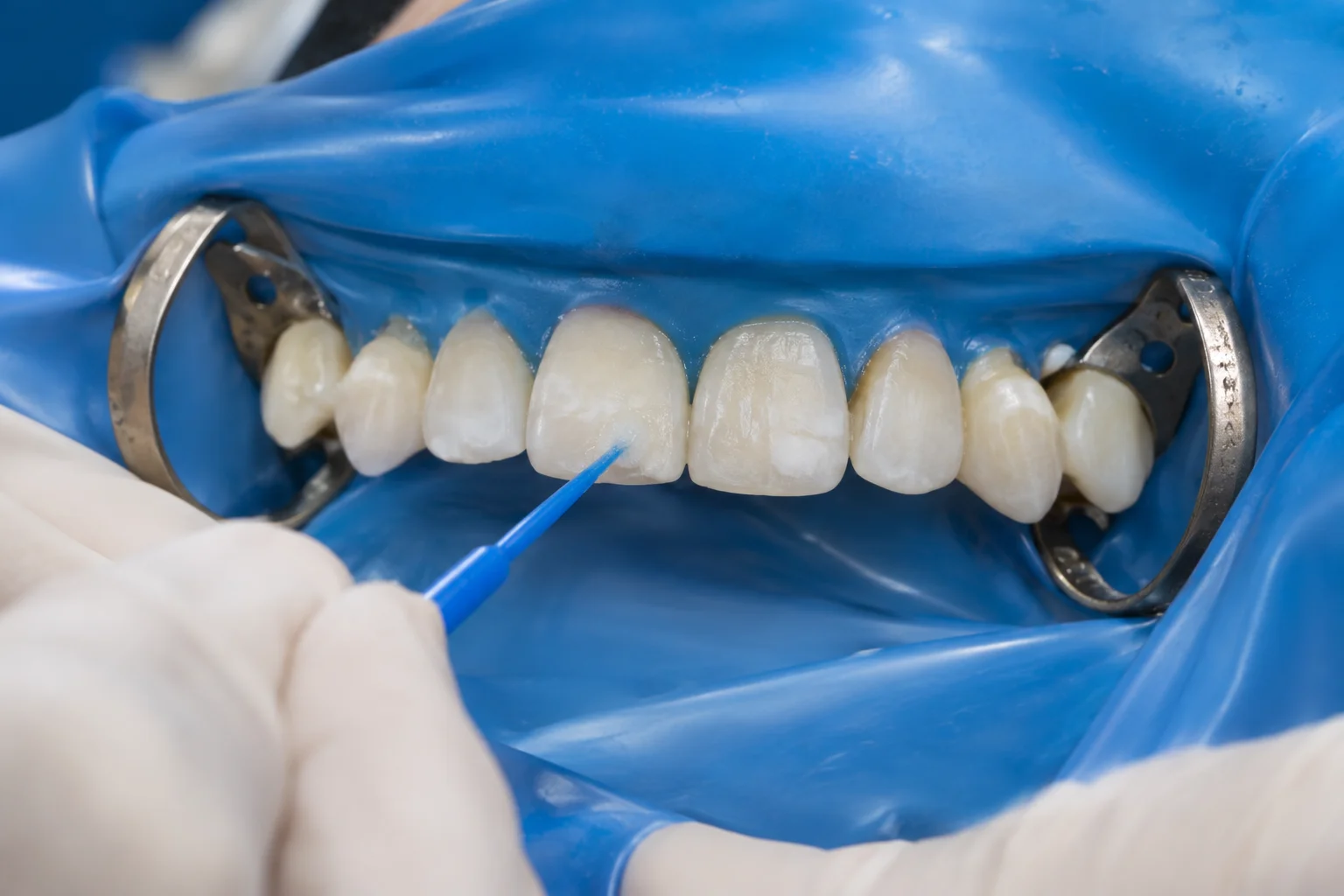
Icon is a resin infiltration treatment for early decay and white spot lesions. A low-viscosity resin is drawn by capillary action into the porous, demineralized area inside the enamel and hardened there, filling the spaces that acid has opened up.
No tooth structure is removed, no anesthetic is needed, and the appointment typically takes under an hour. It sits in a genuine gap in the treatment options: too advanced to reverse with fluoride alone, not advanced enough to justify a filling.
The gap it fills
Tooth decay is a continuum. It begins as demineralization beneath an intact enamel surface, visible as a chalky white spot, and only later does the surface collapse into a cavity.
Until recently the options at the early stage were limited. Fluoride, better home care and dietary change can remineralize a very early lesion and are always the first approach. Once the lesion has progressed beyond that, the traditional answer was to watch it and eventually place a filling, which means drilling into a tooth that has not yet cavitated.
Resin infiltration addresses the lesion while the surface is still intact. It stops the progression by sealing the porous body of the lesion, and because nothing is removed, the tooth is not committed to a restoration cycle.
How the procedure works
The tooth is isolated with a rubber dam to keep it completely dry, which is essential. A hydrochloric acid gel is applied for about two minutes to erode the relatively mineral-dense surface layer that would otherwise block the resin from entering. The tooth is rinsed and then dried thoroughly with alcohol, which also gives a preview of the final appearance.
The infiltrant resin is applied and left for three minutes, during which capillary action draws it into the microscopic pores throughout the lesion. Excess is removed and the resin is light-cured. A second, shorter application is usual, because the resin shrinks slightly on curing and the second round fills what remains.
The surface is then polished. For lesions between teeth, the resin is applied through a perforated film placed in the contact area. The whole sequence is painless and requires no injection.
The cosmetic effect on white spots
White spots look white because the porous, demineralized enamel scatters light differently than the sound enamel around it. Filling those pores with a resin whose refractive index closely matches natural enamel largely eliminates the difference in scatter, and the spot blends into the surrounding tooth.
That makes it a valuable treatment for white spots left after orthodontic treatment, which are common and frustrating, for developmental defects such as mild fluorosis, and for the chalky marks some people have had since childhood.
Results vary with how deep the lesion is. Shallow lesions often disappear almost entirely; deeper ones improve substantially without vanishing. It is worth setting that expectation in advance, and a dry-surface preview during the assessment gives a reasonable indication of what to expect.
Who it suits, and who it does not
It suits early enamel lesions and lesions just into the outer dentin where the surface is still intact, white spot lesions after braces, mild fluorosis, and early decay between teeth caught on a bitewing X-ray in a patient whose decay risk is being managed.
It is not appropriate once a cavity has formed, where the surface has broken down and a filling is needed. It does not work on deeper dentin decay, on stains that sit on the surface rather than within the enamel, or on discoloration caused by tetracycline or trauma.
It also does not address the reason the lesion formed. Diet, home care, saliva flow and fluoride exposure still determine whether new lesions appear elsewhere, and a treated tooth in an unchanged mouth is a partial solution. If you have white marks after orthodontic treatment or early decay that is being watched, ask whether infiltration is an option. Call Cedar Creek Dentistry in Portland.
Questions about your own care? The team at The Best Dentist In Portland, Oregon is happy to help — call us at (503) 646-1811.
This article is for general information only and is not medical advice.