Our Technology
The Intraoral Scanner: Digital Impressions Without the Tray
For anyone who has had a crown, a night guard or orthodontic treatment, the tray full of cold putty is one of dentistry's least pleasant memories. You bite into it, it triggers a gag reflex, and you sit still for several minutes while it sets.
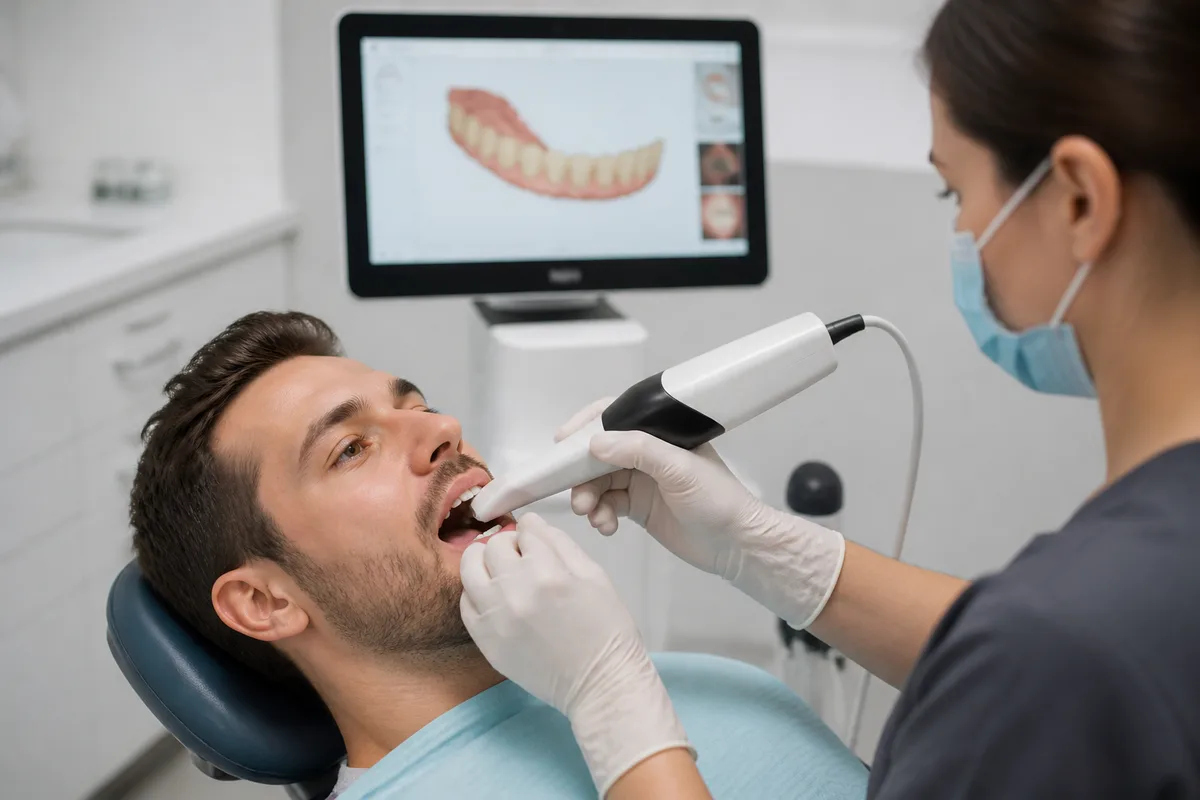
An intraoral scanner replaces that entirely. A small wand is passed over your teeth for a couple of minutes and builds a precise three-dimensional model on screen. Nothing sets in your mouth, nothing is cold, and there is very little to gag on.
How the scan is built
The wand projects structured light or a laser pattern onto the teeth and captures the reflection thousands of times per second from slightly different angles. Software stitches those frames together in real time into a single three-dimensional mesh, accurate to within a few tens of micrometers.
You watch the model appear on the monitor as it is captured. If an area is incomplete, that section is rescanned in seconds rather than the whole impression being repeated, which is one of the biggest practical differences from putty: there is no such thing as a failed impression that has to be started again from scratch.
Both arches and the way they come together in your bite are captured. The result is a digital file that can be sent to a laboratory instantly, fed into an in-office milling unit, or stored and compared against a scan taken years later.
Why accuracy improves
Conventional impression material is dimensionally stable but not perfectly so. It can distort slightly as it sets, when it is removed from the mouth, during disinfection, and while traveling to the laboratory, and the stone model poured from it introduces another small error.
Air bubbles, pulls and drags in the material are common and are often not obvious until the restoration comes back not fitting. Studies comparing digital scanning with conventional impressions for single crowns generally find scanning equal or better, and the difference is more pronounced for multiple units.
A digital file does not distort in transit, does not need pouring, and can be inspected on screen for adequacy before you leave the chair. The margin of the preparation can be magnified and checked, which is exactly the detail that determines whether a crown seals.
What it is used for
Crowns, bridges, inlays, onlays and veneers, whether milled the same day in the office or sent to a laboratory. Implant restorations, using a scan body attached to the implant. Night guards, sports guards and sleep apnea appliances.
Clear aligner therapy depends on it: the entire treatment is planned from the scan, and the movement simulation you are shown at the consultation is generated from your own model. Retainers can be reprinted from a stored scan without another appointment.
It is also a monitoring tool. Scans taken a few years apart can be overlaid to measure tooth wear from grinding, gum recession, and tooth movement objectively, rather than relying on an impression of memory.
The experience, and its limits
Scanning takes roughly two to five minutes per arch. The wand is about the size of an electric toothbrush head, it is not cold, and nothing hardens against your palate. For patients with a strong gag reflex it is a substantial improvement, though the wand still has to reach the back molars.
It also makes the conversation easier, because you can see your own teeth rotated on screen, including the back surfaces you have never looked at.
The limits are real but narrow. Scanning needs a dry, clearly visible preparation margin, so a margin deep below the gum or obscured by bleeding tissue can be difficult and occasionally a conventional impression is still the better tool. Full-arch edentulous cases for dentures remain an area where conventional techniques hold their own. If you are due for a crown or an appliance and dread impressions, tell us. Call Cedar Creek Dentistry in Portland.
Questions about your own care? The team at The Best Dentist In Portland, Oregon is happy to help — call us at (503) 646-1811.
This article is for general information only and is not medical advice.