Our Technology
Prophy-Jet Air Polishing: Stain Removal Without Scraping
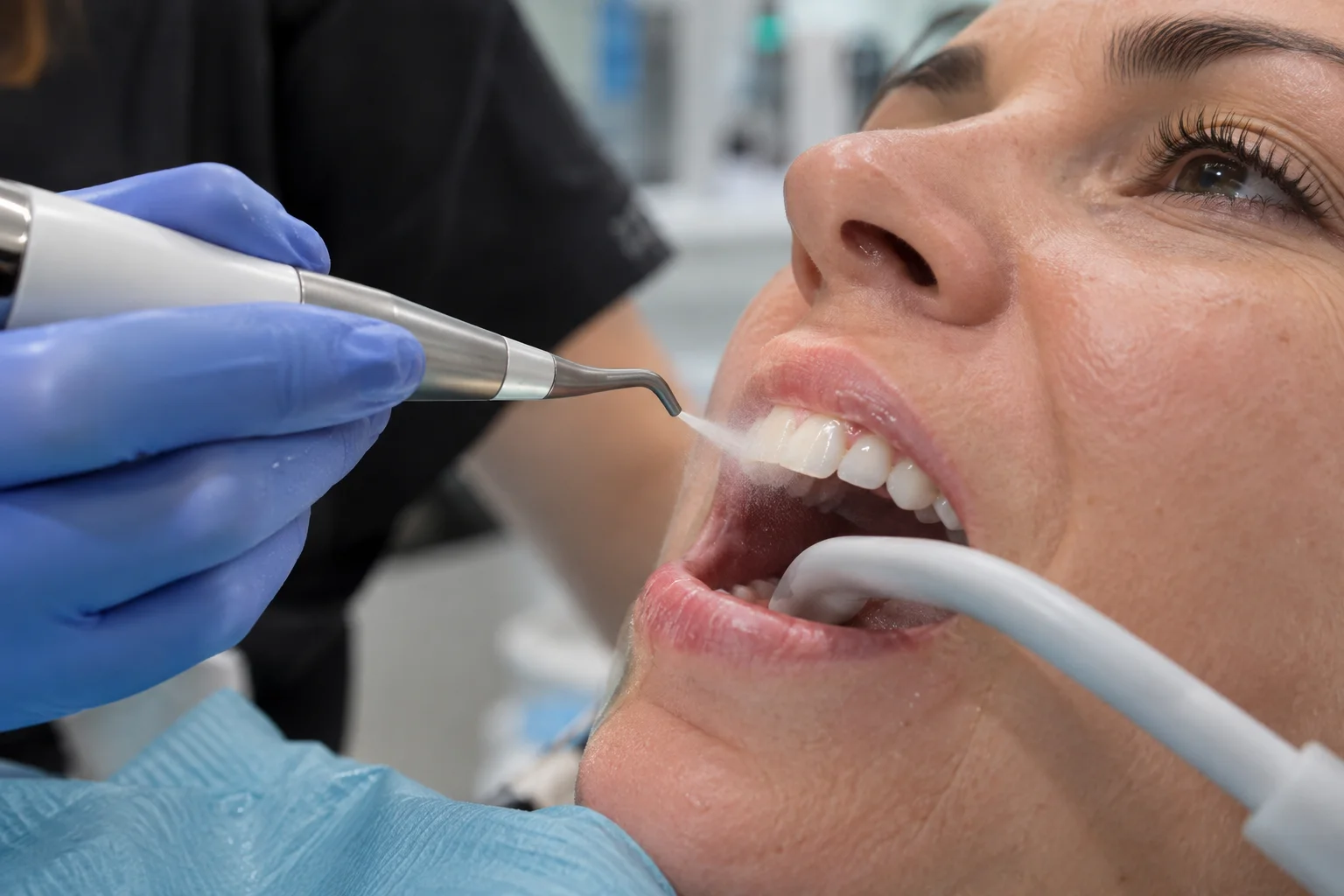
Air polishing, commonly known by the Prophy-Jet brand name, removes surface stain and plaque biofilm with a controlled jet of fine powder carried in compressed air and water. It is the alternative to the rubber cup and gritty paste most people associate with the end of a cleaning.
For heavy coffee, tea, wine or tobacco staining, it is dramatically faster and more thorough than a rubber cup, and it reaches places a cup cannot.
How it works
A handpiece delivers a narrow stream of powder particles suspended in air, surrounded by a cone of water. The particles strike the tooth surface and lift stain and biofilm mechanically, while the water cools the surface and carries away debris.
The powder is the variable that matters. Sodium bicarbonate is the traditional choice: effective, inexpensive and appropriate for enamel above the gumline, but relatively abrasive and salty in taste. Glycine powder has much smaller, softer particles and is gentle enough for use on exposed root surfaces and just below the gumline. Erythritol powder is finer still, is used for subgingival biofilm removal in periodontal maintenance, and around implants where surface damage must be avoided entirely.
The operator controls the angle, distance and time on each surface. Held correctly, the stream is directed away from the gum margin and never held static on one spot.
Compared with a rubber cup polish
A rubber cup with prophy paste works by abrasion, and it works well on the flat, accessible surfaces it can reach. Where it struggles is in pits and fissures, along the gumline, between teeth, and around orthodontic brackets and fixed retainers, because the cup cannot conform to those shapes.
An air polishing stream reaches all of them. It also removes biofilm more completely, and it is significantly faster on heavy staining, where a rubber cup can take several minutes per tooth and still leave stain in the grooves.
The comparison on enamel wear is more nuanced than it looks. Prophy pastes vary widely in abrasiveness, and a coarse paste used repeatedly is not gentle. Glycine and erythritol air polishing is measurably less abrasive to root surfaces than either paste or hand instrumentation.
What to expect, and who it suits
You will feel a fine spray and hear a hiss. There is no vibration and no scraping sensation, which many people who dislike hand instruments prefer. High-volume suction manages the spray, and you may be given protective eyewear and a lip lubricant.
The bicarbonate powders taste salty. Glycine and erythritol are much more neutral, and erythritol is mildly sweet. Some people notice temporary sensitivity afterward.
It is particularly useful before placing sealants, where a spotlessly clean fissure improves bonding; for orthodontic patients; for people with heavy extrinsic stain; and as part of periodontal maintenance for biofilm removal in pockets and around implants.
When it is not used
Sodium bicarbonate powder is avoided in patients on a sodium-restricted diet, and air polishing generally is approached cautiously in people with respiratory conditions such as significant asthma or COPD, since it is an aerosol-generating procedure. Tell us about either.
It is also avoided over recently placed restorations that have not fully set, on some restorative materials that the stream can roughen, in patients with severe periodontal inflammation or open wounds in the mouth, and in patients on certain medications affecting fluid or electrolyte balance.
It removes stain, not tartar. Hardened calculus still has to be removed by scaling, so air polishing is a finishing step rather than a replacement for the cleaning itself. If stubborn staining bothers you, mention it at your next visit and we will use the right powder for your situation. Call Cedar Creek Dentistry in Portland.
Questions about your own care? The team at The Best Dentist In Portland, Oregon is happy to help — call us at (503) 646-1811.
This article is for general information only and is not medical advice.