Our Technology
Rotary Endodontics: Why Root Canals Are Faster Now
If your impression of root canal treatment is a long, tedious appointment, it probably dates from the era of hand files. Cleaning and shaping a root canal used to mean manually twisting a series of stainless steel instruments down each canal, hundreds of strokes per tooth.
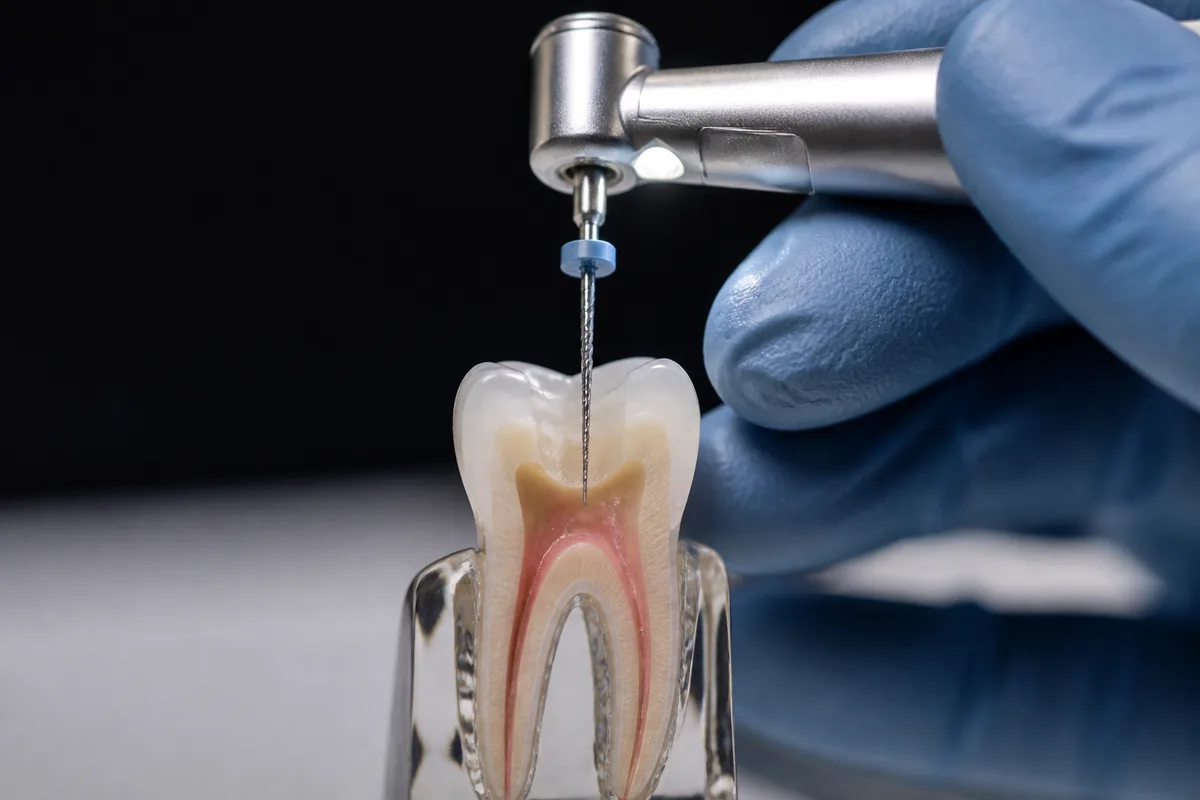
Rotary endodontics replaced that with flexible nickel-titanium files driven by a controlled electric motor. The procedure that once routinely took two long visits is now frequently completed in one, and the shaping is more consistent.
The material is the innovation
Root canals are rarely straight. They curve, sometimes sharply, and a stainless steel file is stiff enough that it tends to straighten a curve rather than follow it. That produced the classic complications of hand instrumentation: ledges cut into the canal wall, transportation of the canal away from its natural path, and perforation in severe cases.
Nickel-titanium alloy is superelastic. It can be bent substantially and return to shape, which means a file made from it follows the natural curvature of a canal instead of fighting it. That single property is what made motor-driven rotation safe enough to use inside a root.
Manufacturing has advanced further since. Heat-treated alloys are more flexible and more resistant to cyclic fatigue, and file geometries have been redesigned so a small sequence of instruments, sometimes as few as one or two, does work that once needed eight or ten.
How the motor makes it safer
Files are driven by an endodontic motor with electronically controlled speed and torque. The torque limit is the safety feature: if a file binds in the canal, the motor stops or reverses before the stress reaches the point of fracture.
Many units also integrate an apex locator, so the motor knows how far down the canal the file has traveled and can slow or stop automatically as it approaches the end of the root. That combination, torque control plus length control, addresses the two things most likely to go wrong.
Reciprocating systems, which rotate the file back and forth through unequal angles rather than continuously, reduce stress on the instrument further and allow some cases to be shaped with a single file.
What it means for the appointment
Shaping a canal is measurably faster, and because the whole procedure shortens, a molar with three or four canals is far more often completed in a single visit. Less time with your mouth open is a real benefit, particularly for anyone with jaw problems.
The shape produced is also more consistent: a smooth, tapering funnel from the access opening to the root tip. That shape is not cosmetic. It allows irrigating solutions to reach the full length of the canal, and irrigation does much of the actual disinfection. It also allows the canal to be filled completely, which is what keeps bacteria from recolonizing.
The result is a procedure that is more predictable and, in published outcome studies, highly successful when the tooth is properly restored afterward.
What it does not change
Rotary instrumentation is one part of endodontic treatment. Diagnosis, thorough anesthesia, isolation with a rubber dam, locating every canal including the ones that are easy to miss, irrigation, and filling all still matter, and a file system does not substitute for any of them.
Nor does it change the most important factor in whether the tooth survives long term, which is the final restoration. A back tooth that has had root canal treatment needs cuspal coverage, and a tooth left with only a temporary filling for months is the one that fails.
If you have been told you need root canal treatment and are dreading it, it is worth knowing the procedure is not what it was. Call Cedar Creek Dentistry in Portland and we will walk you through what actually happens.
Questions about your own care? The team at The Best Dentist In Portland, Oregon is happy to help — call us at (503) 646-1811.
This article is for general information only and is not medical advice.