Our Technology
Ultrasonic and Piezoelectric Scalers
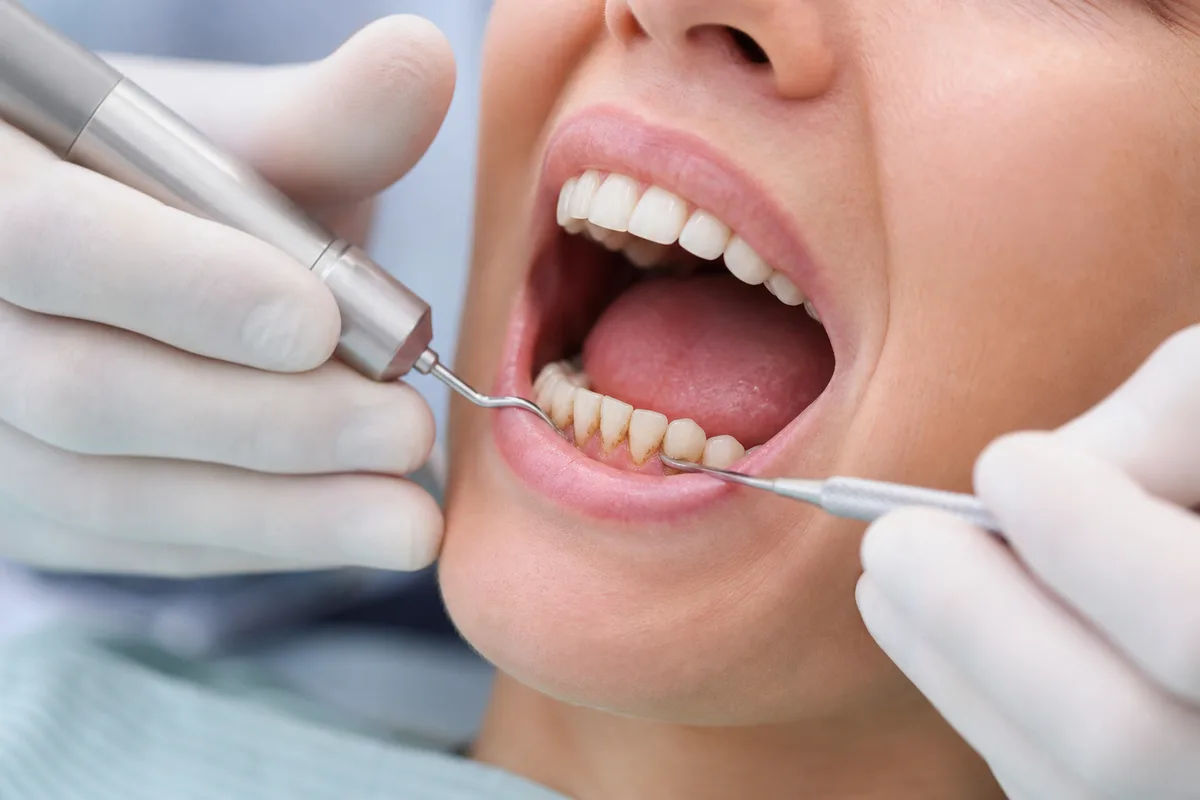
The instrument that makes the high-pitched whistle during a cleaning is an ultrasonic scaler. It does most of the heavy lifting in removing hardened deposits, and it has largely replaced the long sessions of hand scaling that older patients remember.
It is not simply a faster hand instrument. It removes deposits by a different physical mechanism, and that mechanism is why a cleaning today is generally quicker and more comfortable than it used to be.
How high-frequency vibration removes tartar
The working tip of the scaler vibrates at roughly twenty-five to fifty thousand cycles per second, an amplitude so small the movement is invisible. That vibration shatters the bond between hardened calculus and the tooth surface mechanically, in a way a hand instrument achieves only by being pressed and pulled with real force.
A constant water spray runs through the tip, and it does more than cool the instrument. As the tip vibrates, it creates and collapses microscopic bubbles in that water, a process called cavitation, and the energy released disrupts bacterial cell walls and flushes debris out of the space being cleaned. The flow also washes away what has been loosened so it does not get pushed further under the gum.
Two designs are in common use. Magnetostrictive units move the tip in an elliptical path, so all surfaces of the tip are active. Piezoelectric units use a ceramic crystal that flexes when current passes through it, producing a linear back-and-forth motion, so the lateral surfaces do the work. Piezo tips tend to run cooler, generate less heat, and are often preferred for finer work and around implants.
Why it is gentler than it sounds
Hand scaling relies on lateral pressure. To lift a firm deposit, a hand scaler has to be pressed against the tooth and pulled, and repeated across an entire mouth that produces genuine fatigue for both the patient and the hygienist.
An ultrasonic tip is held with light pressure and moved in overlapping strokes. Pressing harder actually reduces its efficiency, because it damps the vibration. That light touch means less force transmitted into sore gums and less pressure against sensitive root surfaces.
The tips are also considerably slimmer than hand instruments, so they reach into deeper pockets and around the roots of molars with less need to push the gum tissue aside. For anyone with periodontal pockets, that matters both for comfort and for how thoroughly the area actually gets cleaned.
What to expect, and who needs a different approach
You will hear a high-pitched hum, feel vibration and water, and a suction tip will be in your mouth managing the spray. It is not painful for most people. If your gums are inflamed, they are tender before the appointment begins and the tenderness is from the inflammation rather than the instrument.
Sensitivity on exposed root surfaces is the most common complaint and is very manageable. Tell your hygienist: the power setting can be lowered, the water made warmer, a different tip selected, a desensitizing agent applied, or topical or local anesthetic used. There is no reason to endure it quietly.
Hand instruments have not disappeared. They finish surfaces, remove residual fine deposits the ultrasonic leaves, and are used where tactile feedback matters. Most cleanings use both. There are also specific situations where ultrasonic use is modified or avoided, including some patients with unshielded older pacemakers, patients at high risk from aerosols, certain restorations and implant surfaces that require specially coated tips, and areas of severe demineralization.
What it does not do
A scaler removes deposits. It does not whiten teeth, and while removing stain and tartar often reveals a lighter tooth color that had been hidden, that is uncovering rather than bleaching.
It also does not treat the cause. Tartar forms because plaque is left along the gumline long enough to mineralize, so the interval between cleanings and the quality of your daily cleaning between teeth determine how much there is to remove next time.
If it has been a while since your last cleaning, or your gums bleed when you brush, the sooner it is dealt with the shorter and easier the appointment is. Call Cedar Creek Dentistry in Portland.
Questions about your own care? The team at The Best Dentist In Portland, Oregon is happy to help — call us at (503) 646-1811.
This article is for general information only and is not medical advice.