Our Services
Dental Implants: A Complete Guide
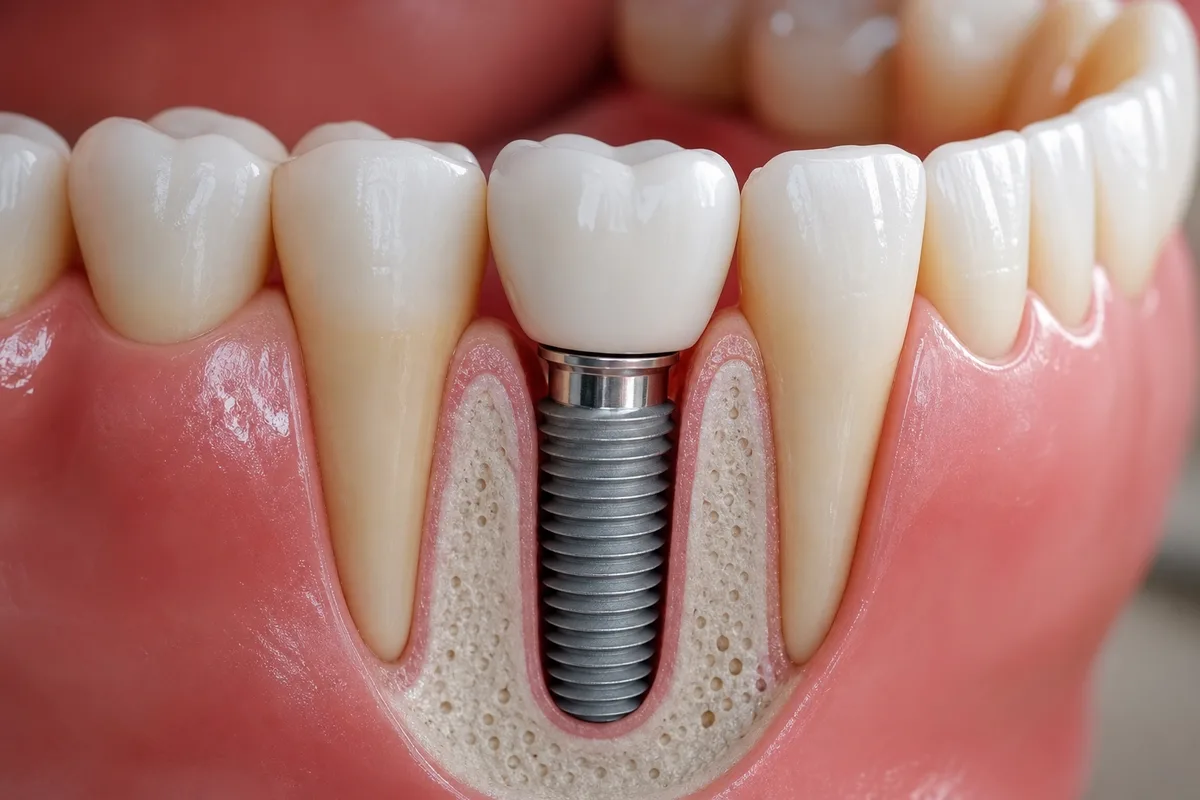
A dental implant is a titanium or zirconia post placed into the jawbone to serve as an artificial tooth root. Over several months the bone grows into direct contact with its surface, a process called osseointegration, and the implant becomes a stable foundation for a crown, a bridge or a denture.
It is the only tooth replacement that restores the root as well as the visible tooth, and that is the reason for most of its advantages.
Why replacing the root matters
Bone maintains itself in response to loading. When a tooth is lost, the bone that held it no longer receives that stimulus and begins to resorb, most rapidly during the first six months and continuing at a slower rate for years. A person who has worn a full denture for decades has a visibly changed lower facial profile because of it.
An implant transmits chewing force into the bone and largely halts this process locally. A bridge or a partial denture rests on top of the gum and does not.
The practical consequences follow from that. Implants do not require cutting down the neighboring teeth the way a conventional bridge does. They cannot decay. They restore chewing force close to that of a natural tooth. And because each one stands alone, a problem with one does not compromise its neighbors.
The process, stage by stage
Planning comes first, usually with a three-dimensional cone beam scan that shows bone volume, bone density, and the exact position of the nerve in the lower jaw and the sinus in the upper. From that scan the final tooth position is designed and a surgical guide can be produced so the implant goes exactly where the crown needs it.
If the tooth is still present, it is removed, frequently with a bone graft placed into the socket at the same appointment to preserve the ridge. Healing before implant placement takes roughly three to four months, though in selected cases an implant is placed at the same visit as the extraction.
Placement itself is a smaller procedure than most people expect. Under local anesthetic, with sedation available, the site is prepared with a sequence of drills at controlled speed with irrigation and the implant is threaded in. It commonly takes under an hour for a single implant and post-operative discomfort is usually less than an extraction. Integration takes three to six months depending on bone quality and whether grafting was done.
Once integrated, an abutment connects the implant to the restoration, a scan or impression is taken, and the final crown is fitted, either screwed into the implant or cemented onto the abutment.
Who is a candidate and what gets in the way
The requirements are adequate bone volume and density, healthy gum tissue, completed jaw growth, and general health sufficient for a minor surgical procedure. Bone deficiency, which is common after a tooth has been missing for years, is usually solvable with grafting, ridge augmentation or a sinus lift in the upper back jaw.
Uncontrolled diabetes impairs healing and raises failure rates, and should be brought under control first. Smoking is the strongest modifiable risk factor and meaningfully increases failure, particularly in the upper jaw. Active periodontal disease must be treated before placement, because the bacteria that destroy bone around teeth also cause peri-implantitis around implants.
Certain medications matter, notably bisphosphonates and related bone drugs, especially intravenous forms used in cancer treatment, and a history of radiation to the jaws. Heavy grinding does not rule out implants but changes the plan, since an implant has no ligament to cushion force and a night guard becomes essential.
Comparing the alternatives honestly
A conventional bridge is faster, typically completed in two to three weeks, and costs less up front. Its drawback is that two healthy teeth must be prepared for crowns to support it, and those teeth then carry the load of three. Bridges commonly serve ten to fifteen years, and when one fails the supporting teeth are often compromised.
A removable partial denture is the least expensive option and the least satisfactory functionally. It is removable, covers gum tissue, can accelerate bone loss under it, and provides a fraction of natural chewing force.
Implants cost more initially and take longer. Over a twenty-year horizon the arithmetic frequently favors them, and the comparison against a bridge should include the value of not sacrificing two healthy teeth. For full arches, implant-supported overdentures anchored by as few as two to four implants transform the stability of a lower denture, which is the single biggest quality-of-life improvement available in this field.
Success rates and long-term care
Implant survival rates are among the best-documented in dentistry, commonly reported above ninety-five percent at ten years in healthy non-smokers with good hygiene. Most failures occur either early, when integration does not take, or years later from peri-implantitis.
Peri-implantitis is inflammation and bone loss around an integrated implant, driven by plaque in exactly the way periodontal disease is, and it is the main long-term threat. It is also largely preventable. Implants need daily cleaning around and under the restoration, often with interdental brushes or a water flosser, and professional maintenance on a schedule.
The implant itself will not decay, but the tissue around it can be lost, and an implant does not warn you with sensitivity the way a natural tooth does. If you are missing a tooth or facing an extraction, the best time to discuss implants is before the tooth comes out. Call Cedar Creek Dentistry in Portland.
Questions about your own care? The team at The Best Dentist In Portland, Oregon is happy to help — call us at (503) 646-1811.
This article is for general information only and is not medical advice.