Our Services
Fluoride Treatment: Who Benefits and Why
Fluoride is among the most studied interventions in public health, and also among the most argued about. The clinical picture is not especially controversial: at the concentrations used in toothpaste, varnish and water, it reduces tooth decay substantially, and the mechanism is well understood.
What is worth understanding is how it works, because that explains who gains the most from a professional application and who genuinely does not need one.
The chemistry, briefly
Enamel is a crystalline mineral. Every time you eat, bacteria in plaque produce acid that dissolves a small amount of mineral out of the enamel surface. Between meals, minerals from saliva move back in. Decay happens when the demineralization consistently outpaces the remineralization.
Fluoride intervenes on both sides. It slows dissolution, it accelerates mineral redeposition, and the crystal that forms when fluoride is present, fluorapatite, is measurably more resistant to acid than the original. It also interferes with the metabolism of the bacteria producing the acid.
This is a surface effect, which is why topical delivery matters. Fluoride in contact with the tooth is doing the work, not fluoride swallowed. The exception is during tooth development in childhood, when systemic fluoride is incorporated into the forming enamel.
What an in-office treatment adds
Toothpaste contains roughly 1,450 parts per million fluoride. Professional varnish contains around 22,600, more than fifteen times as much, in a sticky resin that adheres to the tooth and releases fluoride over several hours rather than being rinsed away in a minute.
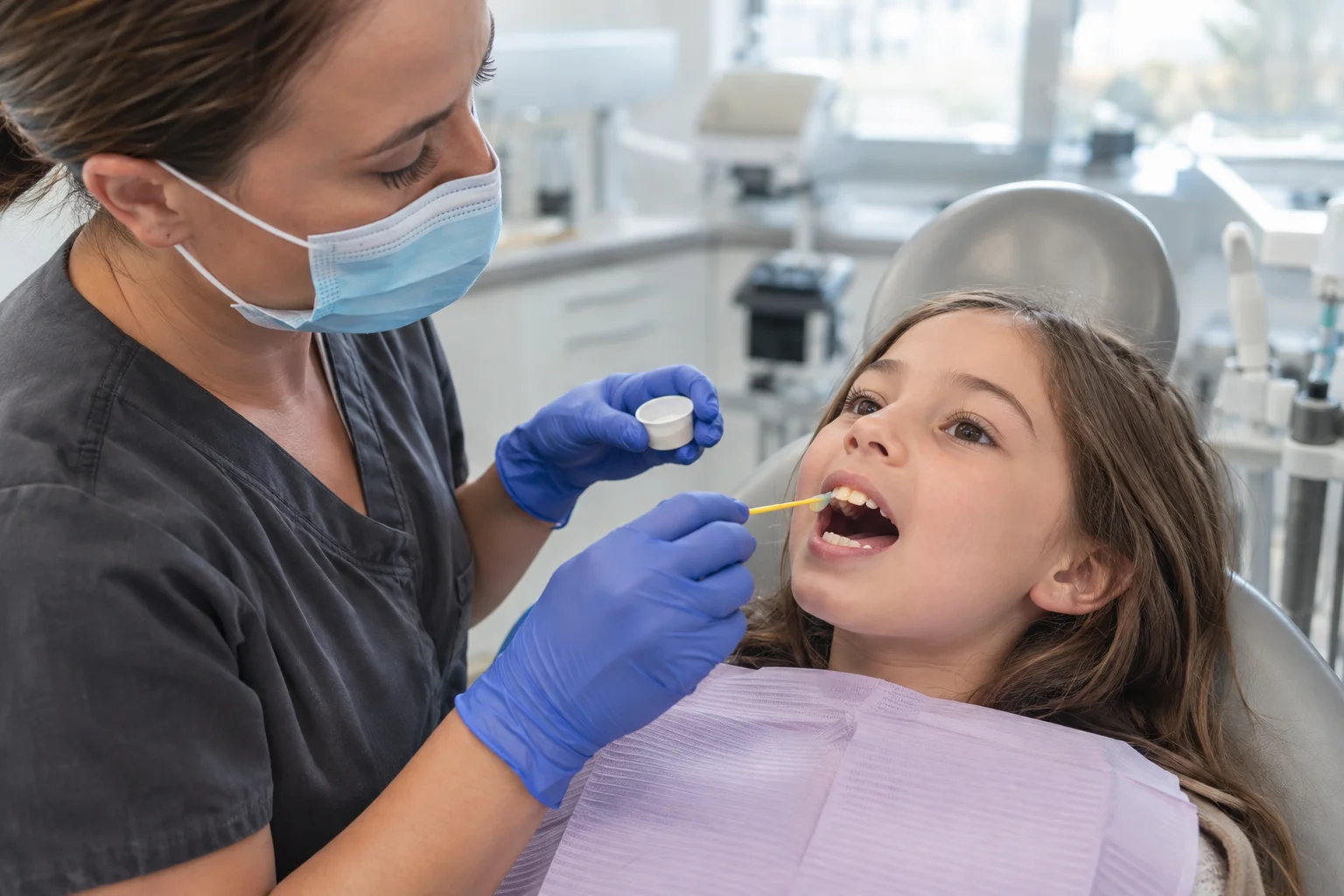
Application takes about a minute. The varnish is painted on with a small brush, sets on contact with saliva, and you avoid hot drinks, alcohol and hard or crunchy food for a few hours, and skip brushing until the next morning, so it stays in contact as long as possible. It is safe from the first tooth onward and is the standard for young children.
Prescription-strength fluoride toothpaste, at 5,000 parts per million and used nightly at home, is the other major tool and is often more valuable than periodic in-office applications for adults at high risk.
Who benefits most
Children and adolescents, whose newly erupted teeth have not fully matured and who have the greatest lifetime benefit from preventing a first cavity. Anyone with a history of frequent decay, since past decay is the strongest predictor of future decay.
Anyone with dry mouth, which is a large and under-recognized group. Hundreds of common medications reduce saliva, as do Sjogren's syndrome, head and neck radiation, and simple aging. Without adequate saliva the natural remineralization process is crippled and decay can accelerate alarmingly fast.
Also: people with gum recession and exposed root surfaces, which decay far more easily than enamel; orthodontic patients, who cannot clean around brackets effectively; people with many crowns, bridges or partial dentures that create plaque traps; and people with frequent acid exposure from reflux, vomiting or a habit of sipping acidic drinks.
Who probably does not need it
An adult with no decay in many years, healthy gums with no recession, normal saliva flow, a low-sugar dietary pattern, and consistent home care with fluoride toothpaste is already well protected. Routine varnish in that situation adds little.
This is worth saying plainly because preventive care should be risk-based rather than reflexive, and many adult insurance plans do not cover fluoride for exactly this reason. A dentist should be able to tell you which category you are in and why.
Safety, honestly stated
The real and documented risk of excess fluoride during childhood is dental fluorosis, which in its common mild form appears as faint white flecks on the enamel and is cosmetic. It comes from swallowing too much fluoride while teeth are forming, which is why children under three should use only a smear of toothpaste the size of a grain of rice, and children three to six a pea-sized amount, with supervision.
Varnish is applied topically in a small quantity and the amount swallowed is negligible. Serious toxicity requires quantities far beyond anything used clinically.
If you are unsure how much fluoride is appropriate for your family, or whether you are in a high-risk group, ask. Call Cedar Creek Dentistry in Portland and we will give you a specific answer rather than a general one.
Questions about your own care? The team at The Best Dentist In Portland, Oregon is happy to help — call us at (503) 646-1811.
This article is for general information only and is not medical advice.