Our Services
Inlays and Onlays: The Middle Ground Between Filling and Crown
Inlays and onlays sit between a filling and a crown. They are custom-made restorations, milled or laboratory-fabricated outside the mouth and then bonded into place, which is what distinguishes them from a filling built up directly in the tooth.
They are sometimes described as partial crowns, and that is a reasonable way to think about them: they cover what needs covering and leave the rest of the tooth alone.
The difference between the two
An inlay fits within the cusps of a tooth, filling the central portion of the biting surface and extending down between the teeth where necessary, but not covering any of the pointed cusps.
An onlay extends over one or more cusps, capping them. That is the important distinction, because covering a cusp protects it from the wedging forces that split teeth. An onlay that covers all the cusps but leaves the sides of the tooth intact is sometimes called an overlay or a table-top restoration.
A crown, by contrast, encircles the entire tooth, which requires reducing all of its outer surfaces. The gap in tooth structure removed between an onlay and a crown is substantial, often the difference between preserving and destroying the outer walls of the tooth.
When they are the right choice
The classic case is a tooth with a large old filling that has failed or has decay around it, where the remaining cusps are thinned and undermined but the outer walls are still sound. A new large direct filling would leave those cusps unsupported and prone to fracture; a crown would require cutting the sound outer walls away.
An onlay protects the weakened cusps while conserving everything that is still healthy. That conservation matters more than it sounds, because every millimeter of retained tooth structure improves the long-term prognosis and keeps the nerve further from the preparation.
They are also well suited to restoring a fractured cusp, to root-canal-treated teeth that need cuspal protection but retain good structure, and to rebuilding worn teeth where vertical height needs restoring. They are not appropriate when too little tooth remains, when the decay extends well below the gumline, or when a tooth needs the encircling reinforcement only a crown provides.
Materials
Ceramic, usually lithium disilicate or a reinforced glass ceramic, is the most common current choice. It bonds strongly to the tooth, matches enamel closely, resists wear and staining, and is kind to the opposing tooth. Bonded ceramic actually reinforces the remaining tooth structure rather than simply occupying space in it, which is a genuine functional advantage over materials that are only cemented.
Composite inlays and onlays, processed outside the mouth, are less expensive, easier to repair and adjust, and slightly gentler on the opposing tooth. They wear faster and stain over time.
Gold remains, purely mechanically, the best material for this purpose: it can be made very thin at the margins, wears at a rate similar to enamel, and gold onlays have documented service lives measured in decades. Its use has declined almost entirely because of appearance and metal cost, but for a back molar in a heavy grinder it is still a defensible recommendation.
How they are made and placed
The tooth is numbed and the old restoration and decay removed. The preparation is then shaped with slightly diverging walls and rounded internal angles so the restoration can seat, and any undercut areas are filled. Notably, less healthy tooth is removed than for a crown.
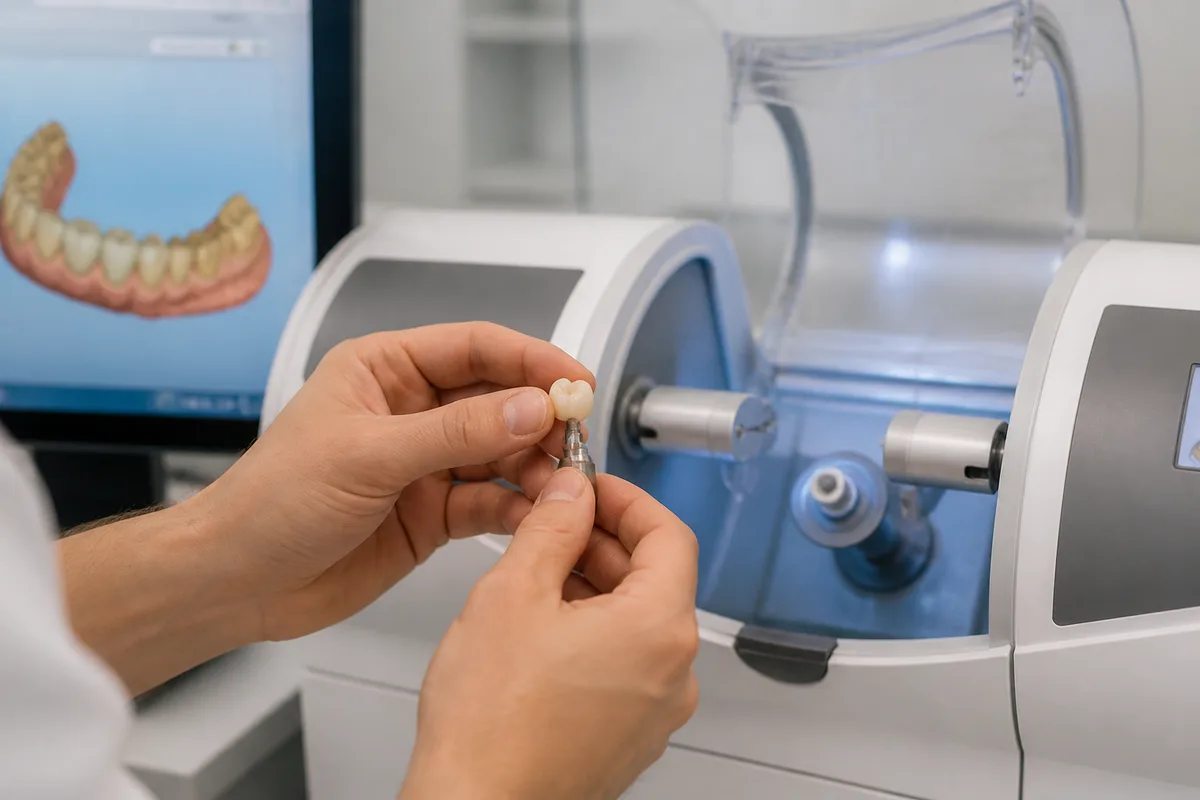
With chairside milling, the tooth is scanned, the restoration designed and milled in the office, and bonded at the same visit. With a laboratory, a scan or impression is taken, a temporary placed, and the finished restoration bonded two to three weeks later.
Bonding is the technique-sensitive step and largely determines how long the restoration lasts. The tooth is isolated to keep it completely dry, the surfaces treated with etchant and bonding agent, the ceramic conditioned on its fitting surface, and resin cement used to lute the two together and cured. Excess cement is removed carefully from the margins and between the teeth, then the bite is checked and the margins polished.
Cost, longevity and care
Inlays and onlays cost more than a direct filling and typically slightly less than or similar to a crown. Studies of bonded ceramic onlays commonly report survival in the region of ninety percent at ten years, comparable to crowns, with the added benefit of conserved tooth structure.
Failures are most often decay at the margin or fracture in heavy grinders, which are the same failure modes as any restoration. A night guard is worth having if you grind.
Care is ordinary: brush and floss with attention to the margins, which is where the tooth underneath can still decay. If you have a tooth with a large failing filling and have been told it needs a crown, it is reasonable to ask whether an onlay would do the job with less tooth removed. Call Cedar Creek Dentistry in Portland and we will show you what is left of the tooth and explain the choice.
Questions about your own care? The team at The Best Dentist In Portland, Oregon is happy to help — call us at (503) 646-1811.
This article is for general information only and is not medical advice.