Our Services
Oral Surgery: Procedures, Recovery, and What to Expect
Oral surgery covers the surgical procedures performed in and around the mouth and jaws. In a general practice that means wisdom teeth, surgical extractions, biopsies, minor soft tissue procedures, and surgery that prepares the mouth for implants or dentures.
Most of these are done under local anesthetic with sedation available, take under an hour, and heal in a week or two. Knowing what to expect removes most of the apprehension.
Wisdom teeth
Third molars arrive in the late teens or early twenties, into a jaw that often has no space for them. When they cannot erupt fully they become impacted, either against the tooth in front, at an angle, or entirely within the bone.
The reasons to remove them are specific: recurrent pericoronitis, the painful infection of the gum flap over a partially erupted tooth; decay in the wisdom tooth or, more importantly, in the second molar where it is trapped against it; cyst formation around an impacted tooth; damage to the root of the adjacent tooth; and periodontal pocketing behind the second molar.
Fully impacted, symptom-free, disease-free wisdom teeth in an older adult are frequently better monitored than removed, and the debate about prophylactic removal is genuine. Where removal is indicated, doing it in the late teens or early twenties is easier: the roots are less fully formed, the bone is more elastic, and recovery is faster.
The procedure involves an incision, often removing a small amount of bone, sectioning the tooth so each part comes out along its own path, and sutures. The main specific risks are nerve injury in the lower jaw, usually temporary, and communication with the sinus in the upper jaw, both of which are assessed in advance with imaging.
Surgical extractions and site preparation
A tooth broken at the gumline, with curved or divergent roots, with a root fused to bone, or previously root-canal-treated and brittle is removed surgically rather than simply lifted out. Sectioning the tooth is the gentler approach, because it avoids applying force to the surrounding bone.
Where an implant is planned, a bone graft is typically placed in the socket at the same appointment to preserve ridge volume, which usually saves a larger grafting procedure later. Alveoloplasty, the smoothing of sharp bony ridges after multiple extractions, and removal of excess or flabby tissue are done to prepare a ridge that a denture can sit on comfortably.
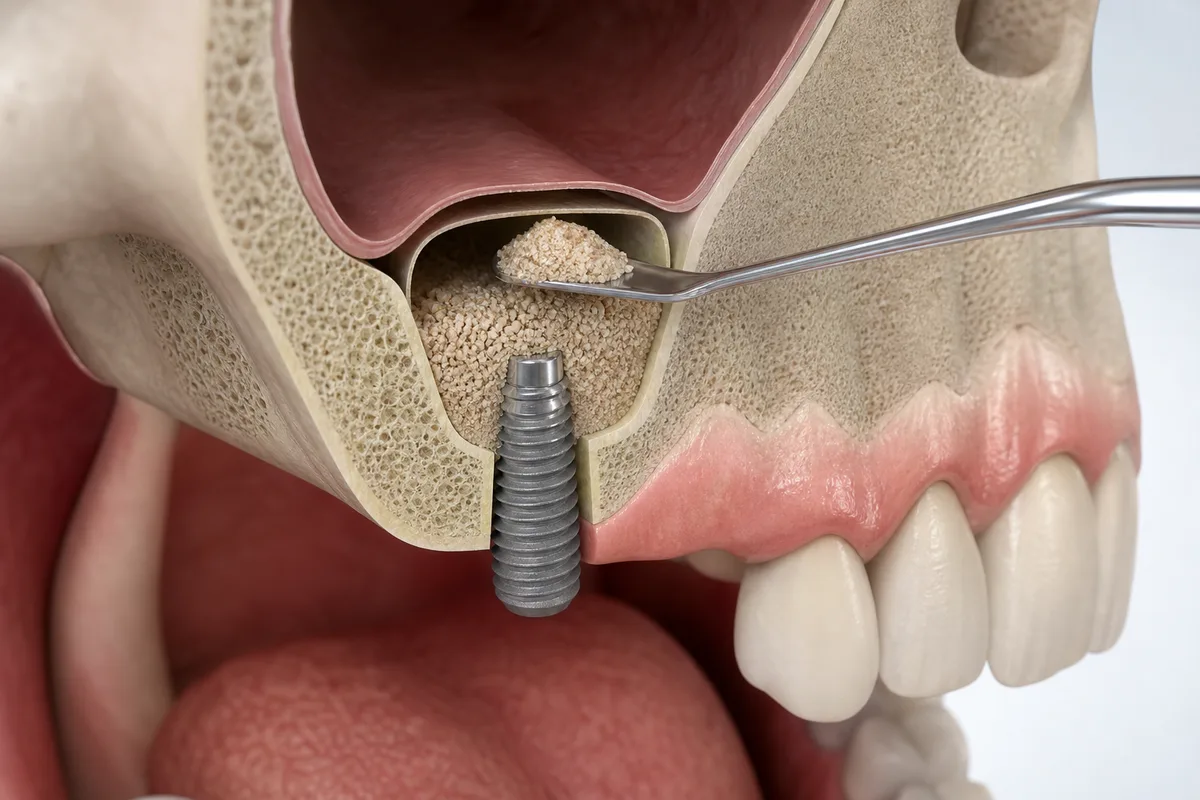
Crown lengthening exposes more tooth structure by reshaping gum and bone, making a tooth broken near the gumline restorable. A sinus lift or ridge augmentation rebuilds bone where implants are planned.
Soft tissue procedures
A frenectomy releases a frenum, the band of tissue connecting lip or tongue to the gum. A tight lingual frenum can restrict tongue movement and affect infant feeding and sometimes speech. A prominent labial frenum between the upper front teeth can hold a gap open, and releasing it is usually done alongside or after orthodontic closure. These are short procedures, often done with a laser, and heal quickly.
Biopsy of a lesion that has not resolved is a small procedure and the only definitive way to obtain a diagnosis. Being referred for one is a way of finding out, not a diagnosis in itself.
Exposure of an impacted tooth, most often an upper canine, is done in coordination with an orthodontist: the tooth is uncovered and a bracket with a chain attached so it can be guided into position over the following months.
Anesthesia and comfort
Local anesthetic alone is sufficient for most procedures and means you are awake and aware but feel no pain, only pressure and movement. Nitrous oxide added to local anesthetic reduces anxiety, takes effect within minutes and wears off within minutes, so you can drive yourself home.
Oral sedation with a tablet taken beforehand produces a drowsy, detached state with partial amnesia for the procedure, and requires someone to drive you. Intravenous sedation goes further and is used for longer surgical cases and for significant dental anxiety. General anesthesia is reserved for extensive surgery or specific patient needs.
Discuss your anxiety honestly beforehand rather than trying to get through it. The options exist for exactly this reason and using them is not an indulgence.
Recovery, realistically
The first twenty-four hours protect the clot: bite on gauze with firm pressure, no rinsing, no spitting, no straws, no smoking, and no vigorous activity. Keep your head elevated and use ice on the outside of your face in twenty-minute cycles.
Swelling peaks around day two or three and then improves; swelling that increases after day three is a reason to call. Bruising on the face and neck can appear and is unalarming. Discomfort is generally well controlled by alternating ibuprofen and acetaminophen on a schedule, which for dental pain is more effective for most people than an opioid. Limited mouth opening and jaw stiffness for several days after wisdom tooth removal is normal.
Eat soft, cool foods and stay hydrated. Begin gentle warm salt water rinses the day after and keep brushing the rest of your teeth. Take any prescribed antibiotics to completion. Call promptly for bleeding that has not slowed after several hours of firm pressure, a deep throbbing ache appearing on day three to five that suggests dry socket, fever, difficulty swallowing or breathing, or numbness persisting well beyond the expected duration.
If you have a tooth or a wisdom tooth that has been causing trouble, an evaluation with imaging will tell you what is actually involved. Call Cedar Creek Dentistry in Portland.
Questions about your own care? The team at The Best Dentist In Portland, Oregon is happy to help — call us at (503) 646-1811.
This article is for general information only and is not medical advice.