Our Services
Scaling and Root Planing: The Deep Cleaning Explained
Being told you need a deep cleaning instead of a regular one often feels like an upsell. It is a reasonable suspicion and it deserves a straight answer: scaling and root planing is a different procedure, treating a different condition, with different instruments, different anesthesia and a different code.
A routine cleaning is preventive maintenance for healthy gums. Scaling and root planing is the treatment for periodontal disease, which is an infection of the tissue and bone that hold your teeth in place.
What the numbers mean
At periodontal appointments your hygienist measures the depth of the crevice between gum and tooth at six points around every tooth and calls out numbers. In health, that crevice is one to three millimeters deep and a toothbrush and floss can keep it clean.
When plaque persists at the gumline, the tissue becomes inflamed, detaches slightly, and the crevice deepens into a pocket. At four millimeters and beyond, home care can no longer reach the bottom of it, and neither can a routine cleaning instrument. Bacteria in that protected space produce toxins, the body's inflammatory response destroys the bone around the tooth, and the pocket deepens further. It is a self-sustaining cycle.
Bleeding when probed is the other key sign, because healthy gums do not bleed. Bone loss visible on X-rays confirms how far the process has gone. Together these findings, not a general impression, determine whether scaling and root planing is indicated.
What the procedure involves
The mouth is usually treated in sections, commonly two halves or four quadrants, over one or two appointments. Local anesthetic is used, because the work extends well below the gumline onto the root surfaces.
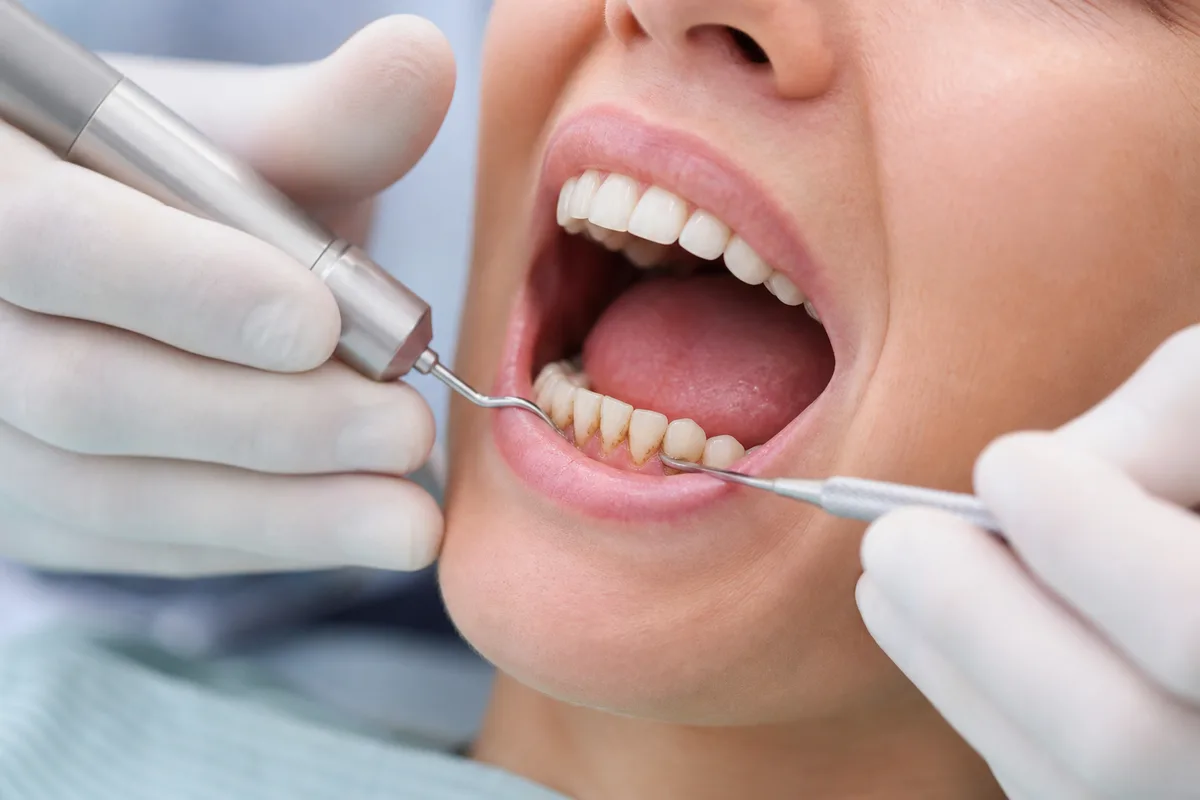
Scaling removes plaque and hardened tartar from the crown and root surfaces, above and below the gum, using ultrasonic instruments and hand scalers. Root planing smooths the root surface itself, removing contaminated cementum and the rough deposits that bacteria adhere to, so the gum tissue can reattach closely to a clean surface.
Some cases include locally delivered antibiotic placed directly into deeper pockets, or laser treatment of the pocket lining. These are adjuncts to the mechanical cleaning, not replacements for it.
Recovery and what to expect
Soreness and sensitivity for several days is normal. Cold sensitivity often increases temporarily because tartar that had been insulating exposed root surfaces is now gone and the gums shrink slightly as inflammation resolves. It typically improves over a few weeks and a desensitizing toothpaste helps.
Gums may look slightly more recessed afterward. This is the swelling going down rather than new damage, though it can be visually surprising at the front of the mouth.
Rinse with warm salt water, eat softer foods for a day or two, and keep brushing and flossing gently right away. The tissue heals over the following four to six weeks, and a re-evaluation appointment at that point re-measures the pockets to see how much has resolved.
What happens next matters more than the procedure
Scaling and root planing resets the situation; it does not cure periodontal disease, which is a chronic condition. The bacteria in treated pockets repopulate over roughly three months, which is why periodontal maintenance appointments are scheduled at three- to four-month intervals rather than every six months.
Skipping back to a twice-a-year schedule is the most common reason treated cases relapse. Insurance often covers maintenance at a different frequency than routine cleanings, and it is worth checking what yours allows.
Home care has to change too. Cleaning between the teeth daily is no longer optional, and for deeper areas interdental brushes are usually more effective than floss. Smoking is the strongest modifiable risk factor in periodontal disease, both for developing it and for treatment failing.
If pockets do not resolve
Most areas respond well. Some deep pockets, particularly around molars with root furcations, do not close with non-surgical treatment alone, and those may be referred for periodontal surgery to access and reshape the area, or for regenerative grafting where bone has been lost.
The goal throughout is to stop further loss. Bone that has already been destroyed does not usually come back on its own, but disease that has been stabilized can hold for decades, and teeth that once felt doomed frequently stay in service for the rest of a person's life.
If your gums bleed when you brush, or you have been told you have pockets, do not wait for it to hurt, because it will not. Call Cedar Creek Dentistry in Portland.
Questions about your own care? The team at The Best Dentist In Portland, Oregon is happy to help — call us at (503) 646-1811.
This article is for general information only and is not medical advice.