Our Services
Teeth Whitening: Your Options, Explained
Whitening is the most requested cosmetic treatment in dentistry and the one with the widest gap between what is promised and what is delivered. The chemistry is genuinely effective. Most disappointment comes from using the right product on the wrong kind of discoloration, or expecting a result the material cannot produce.
Getting a good outcome starts with identifying what is actually causing the color.
Two different kinds of discoloration
Extrinsic staining sits on the outside of the enamel and comes from coffee, tea, red wine, dark sauces, tobacco and certain mouthrinses. Enamel is porous at a microscopic level and pigment accumulates in those pores over years. This type responds well to whitening and often improves considerably with a professional cleaning alone.
Intrinsic discoloration is inside the tooth. It comes from aging, as enamel thins and the naturally yellower dentin underneath shows through more; from trauma, which can darken a single tooth; from tetracycline exposure during tooth development, producing gray or banded discoloration; and from excess fluoride during development, producing white or brown mottling.
Peroxide can lighten many intrinsic cases, but tetracycline staining in particular is stubborn, may take months of nightly treatment, and sometimes is better addressed with veneers or bonding. A single dark tooth from an old injury is often treated with internal bleaching, done from inside a root-canal-treated tooth, which is a completely different procedure.
How whitening works and where it cannot
Hydrogen peroxide and carbamide peroxide, which breaks down into hydrogen peroxide, pass through enamel and dentin and break apart the large pigmented molecules trapped there into smaller, less visible ones. This is a chemical change, not abrasion, which is why whitening toothpastes, which mostly work by polishing away surface film, produce a limited result.
Crowns, veneers, bonding and fillings do not whiten at all. They are inert materials whose color was fixed when they were made. This matters enormously if you have a tooth-colored filling in a front tooth: whiten the surrounding teeth and the filling will suddenly look darker. The fix is to whiten first, wait a couple of weeks for the shade to stabilize, and then replace the restoration to match.
Whitening also does not fix white spots, which often become temporarily more noticeable during treatment before evening out somewhat afterward.
Comparing the options
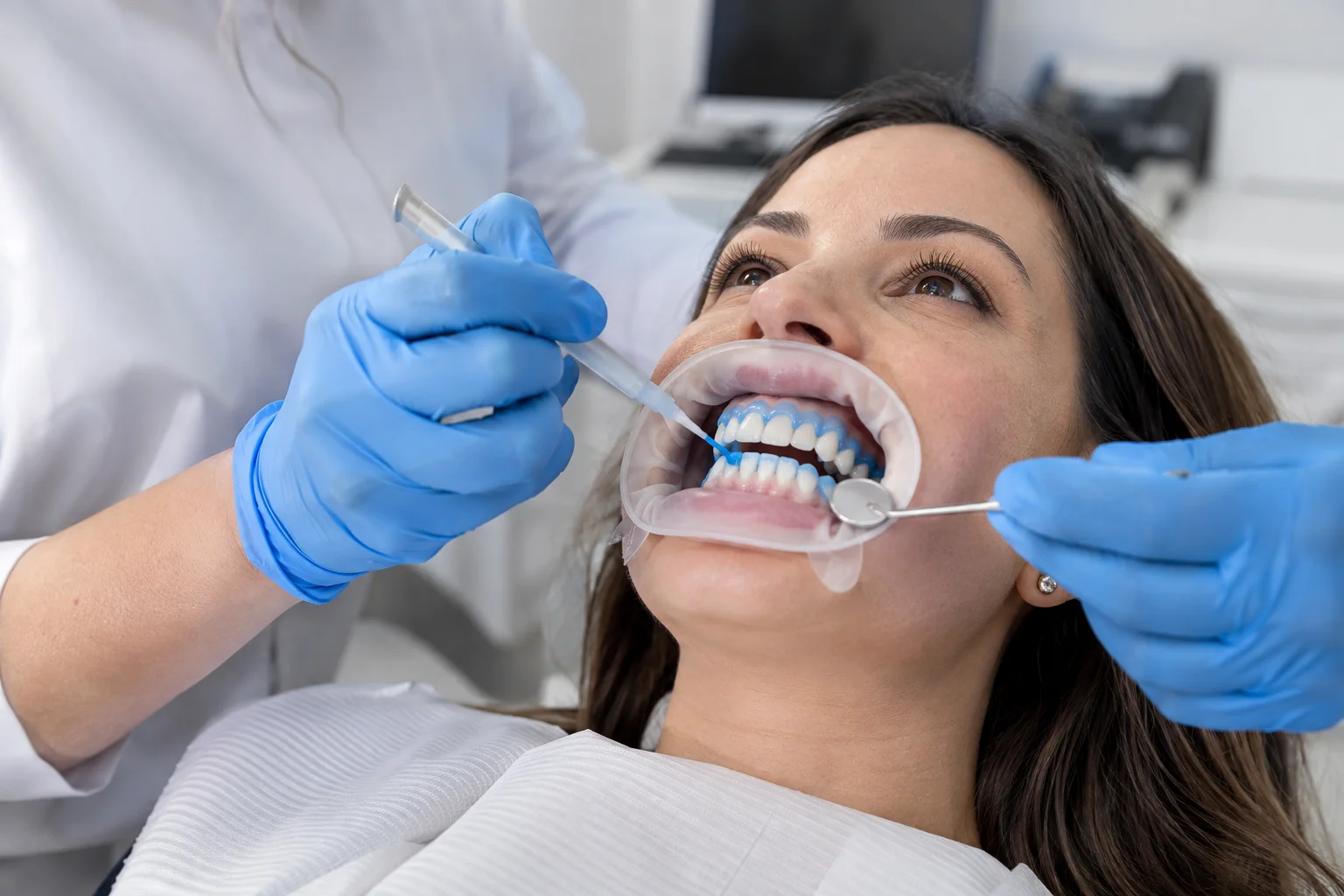
In-office whitening uses a high concentration of peroxide with the gums carefully isolated, over roughly sixty to ninety minutes. It produces the most dramatic single-session change and is the right choice when there is a deadline. It is also the most expensive and carries the highest chance of short-term sensitivity.
Custom tray whitening is, for most people, the best value. Impressions or scans are used to make thin trays fitted to your teeth, and you wear them with a lower-concentration gel for thirty minutes to a few hours daily, or overnight, for one to two weeks. The gradual approach produces results comparable to in-office treatment with less sensitivity, and you keep the trays for touch-ups indefinitely, which is the real long-term advantage.
Over-the-counter strips work, modestly. They use lower concentrations and a one-size-fits-all delivery that does not adapt to your tooth shape, so results are less even, particularly if your teeth are crowded. They are a reasonable, inexpensive starting point for mild extrinsic staining. Charcoal pastes and similar trend products are abrasive and can wear enamel without whitening it; avoid them.
Sensitivity, and how to manage it
Temporary sensitivity affects a large share of people who whiten. Peroxide passes through the enamel to the dentin and irritates the nerve, producing sharp zings or a background ache. It is reversible and stops after treatment ends, without lasting damage to the tooth.
Practical measures: use a potassium nitrate desensitizing toothpaste for a week or two beforehand and throughout, shorten the daily wear time rather than stopping entirely, take a day off between sessions, and avoid very hot and very cold drinks during the course. Gum irritation from gel overflow is handled by using less gel and wiping away excess.
If you have untreated decay, leaking fillings, active gum disease or exposed roots, treat those first. Whitening over an existing problem is uncomfortable and occasionally harmful.
Keeping the result
Whitening is not permanent. Expect gradual regression over one to three years depending on your habits, with heavy coffee, tea, red wine and tobacco use accelerating it considerably. Rinsing with water after staining drinks and using a straw for iced coffee both help more than people expect.
Touch-ups with custom trays, a night or two every few months, maintain the result with minimal cost. This is the main reason trays are worth the initial investment.
If you are considering whitening, particularly if you have fillings or crowns in the front of your mouth, get an evaluation first so the sequence is right. Call Cedar Creek Dentistry in Portland.
Questions about your own care? The team at The Best Dentist In Portland, Oregon is happy to help — call us at (503) 646-1811.
This article is for general information only and is not medical advice.