Our Technology
Air Abrasion: Treating Small Cavities Without the Drill
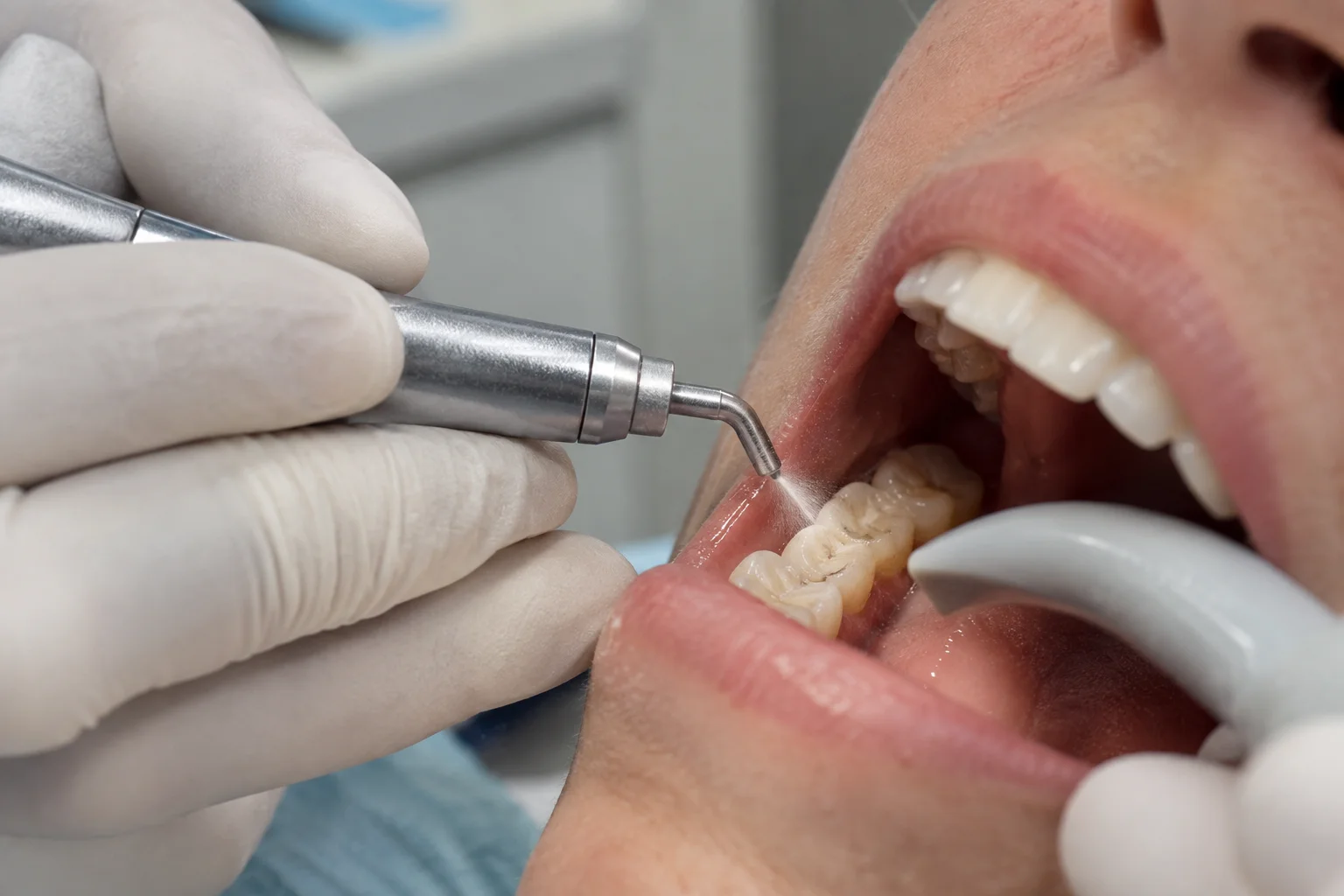
Air abrasion removes decay with a narrow stream of fine aluminum oxide particles propelled by compressed air. No rotating bur touches the tooth. There is no vibration, no heat, and no drill sound.
For small, early cavities in accessible places, it is frequently the right tool, and it is often done without any anesthetic at all. It is not a replacement for the drill in general, and being clear about where the line falls is the useful part.
How it works
A handpiece delivers a stream of aluminum oxide particles, typically around twenty-seven micrometers in diameter, at high velocity through a very small nozzle. The particles strike the tooth and remove material by microscopic abrasion, a fraction at a time.
Decayed tooth structure is softer than sound enamel and dentin, so it abrades away faster. A skilled operator uses that differential to remove decay while leaving healthy structure behind, which is the core appeal of the technique: preparations tend to be smaller and more conservative than a bur would produce.
Because there is no rotation and no friction against the tooth, there is no heat generation and essentially no vibration. Both of those are significant, because heat and vibration transmitted into the pulp are what produce much of the discomfort associated with drilling.
What it is good for
Small, early cavities, particularly in the pits and fissures of the biting surfaces of back teeth, are the classic indication. Those lesions are frequently detected while still small, and treating them with air abrasion avoids cutting the wider access a bur requires.
Preparing a tooth surface for sealants is another common use. Cleaning out a suspicious fissure with air abrasion before sealing both removes any early demineralization and roughens the enamel, improving how well the sealant bonds and how long it lasts.
It also removes surface stain, prepares surfaces for bonding, and can be used to remove old composite restorations selectively. For children and for anxious adults, the absence of the drill sound and sensation is a meaningful benefit in itself, and many of these procedures are done without an injection.
Where it falls short
It cuts slowly compared with a bur, which makes it impractical for large cavities. Removing a failed large amalgam or preparing a tooth for a crown with air abrasion would take an unreasonable amount of time.
It has no tactile feedback. A dentist using a bur feels the difference between soft decayed dentin and hard sound dentin through the handpiece. With air abrasion that feedback is absent, so the operator relies on vision, magnification and caries-detecting dye, which demands care.
It does not produce the sharp internal angles and defined walls that some restorations need for mechanical retention, so it works best with bonded materials such as composite. It also struggles to reach decay between teeth where the surfaces touch, and it is not the right tool for deep decay approaching the nerve, for removing metal restorations, or where mechanical retention is required. Isolation is essential, because a fine particle stream needs high-volume suction and protective eyewear for everyone in the room.
The wider point about early detection
Air abrasion is only an option when a cavity is found early, while it is still small and confined. A lesion that has been growing for two years undetected is a filling or a crown, not a candidate for micro-abrasion.
That is an argument for regular examinations and appropriate imaging rather than for the technique itself. The conservative treatments, air abrasion, resin infiltration, remineralization with fluoride, all live at the early end of the disease and disappear as options once decay is established.
If you have small areas being watched, or you have avoided treatment because of the drill, it is worth asking whether air abrasion suits your situation. Call Cedar Creek Dentistry in Portland.
Questions about your own care? The team at The Best Dentist In Portland, Oregon is happy to help — call us at (503) 646-1811.
This article is for general information only and is not medical advice.